Mirko Deanović, Josip Torbarina, Branimir Truhelka
The collection of works on Ruđer Bošković includes his letters, literary connections with the English, and biographical and scientific contributions. It is an important source for studying the life and work of the great scientist.
Jugoslavenska akademija znanosti i umjetnosti (JAZU), 1950.
The Fifth Scientific Congress of Slavonia and Baranja, Vol. 1, brings together papers on Slavonia-Baranja history under Turkish rule, cultural and educational development, and literary, linguistic, and health heritage.
Jugoslavenska akademija znanosti i umjetnosti (JAZU), 1991.
Croatian. Latin alphabet. Hardcover with dust jacket.
18.4216.58 €
Archaeology • Ethnology • Culturology • Cultural history • Collections and chronologies
The collection is an interdisciplinary bridge between Ukrainian and Croatian science, encouraging comparative research on Slavic migrations. It presents the Carpathians as a "living archipelago" connecting East and West, important for Croatian ethnogenesi
Filozofski fakultet Sveučilišta u Zagrebu, 2014.
Croatian. Latin alphabet. Paperback.
18.34 €
Education • Pedagogy • Sociology • Croatian history • 20th Century • Collections and chronologies
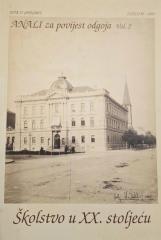
The collection "Education in the 20th Century", published in 2003 in Annals for the History of Education (vol. 2), contains papers from the professional-scientific meeting in Zagreb (October 25-27, 2001), held on the occasion of the 100th anniversary of t
Hrvatski školski muzej, 2003.
Croatian. Latin alphabet. Paperback.
5.98 €
Culturology • Sociology • Collections and chronologies
The scientific study Religion, Politics, Secularism (2021) by Rusmir Šadić analyzes the complex relations between religious communities, political powers and the process of secularization in contemporary society.
Logos, 2021.
Croatian. Latin alphabet. Hardcover.
12.98 €
Political philosophy • Contemporary philosophy • Collections and chronologies
The collection is an important contribution to the revitalization of Konstantinović's thought in the post-Yugoslav space, demonstrating that his critique of the rural mind remains relevant for understanding contemporary social and political pathologies.