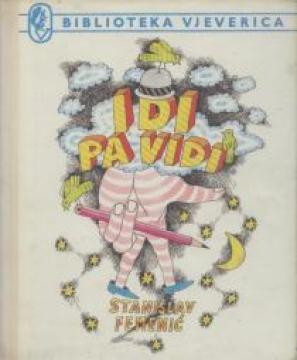
Idi pa vidi

Idi pa vidi

Stanislav Femenić

Stanislav Femenić published a number of collections of poems for children. Each of them is characterized by a variety of motifs and primarily by the poet's preoccupation with nature.

The collection Idi pa vidi contains several autobiographical poems. The author sings about nature, but also about childhood romantic crushes and daydreams. He enriched the collection with haiku verses, a well-known Japanese form of only three verses. In them, cheerfulness is replaced by quiet thought and deep life wisdom.

Editor
Vera Barić
Illustrations
Ante Zaninović
Graphics design
Ante Zaninović
Dimensions
21 x 17 cm
Pages
121
Publisher
Mladost, Zagreb, 1990.
 
Latin alphabet. Hardcover.
Language: Croatian.
ISBN
8-60-500530-0

No copies available

The last copy was sold recently.
 

Are you interested in another book? You can search the offer using our search engine or browse books by category.

You may also be interested in these titles

Tikva s nosom

Tikva s nosom

Stanislav Femenić
Mladost, 1981.
Croatian. Latin alphabet. Hardcover.
5.28
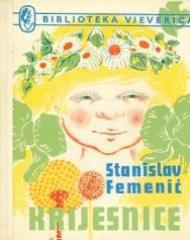
Krijesnice

Krijesnice

Stanislav Femenić

A collection of children's poetry published in 1973 (first edition, later 1975, 1977, 1980, 1982). Stanislav Femenić, a Croatian poet, storyteller and physician (1924–2012), dedicated most of his work to children and young people.

Mladost, 1973.
Croatian. Latin alphabet. Hardcover.
5.88 - 8.34
Trči, trči Trčimir

Trči, trči Trčimir

Stanislav Femenić
Školska knjiga, 1988.
Croatian. Latin alphabet. Hardcover.
4.26 - 4.32
Dva puta za jug

Dva puta za jug

Lara Mitraković

The intense saturation and density of this poetry make it impossible to read this book in one sitting. It must be taken slowly and measuredly, as each poem requires a longer process of reception.

Fraktura, 2019.
Croatian. Latin alphabet. Hardcover with dust jacket.
7.985.99
Crni zec (sabrane i nove pjesme)

Crni zec (sabrane i nove pjesme)

Drago Glamuzina

The title poem, "The Black Rabbit," represents a kind of symbolist maneuver within "real" poetry, because like Baudelaire's "Albatross," it possesses a pronounced unambiguous charge.

Vuković & Runjić, 2022.
Croatian. Latin alphabet. Paperback.
8.56 - 9.98
88

88

Nadija Rebronja

A piano usually has 88 keys, 52 white and 36 black, from which 88 tones emerge. A pianist usually reads 88 notes. These 88 micro-proses simultaneously constitute one piano and one piano concerto.

Buybook, 2022.
Croatian. Latin alphabet. Paperback.
5.944.75