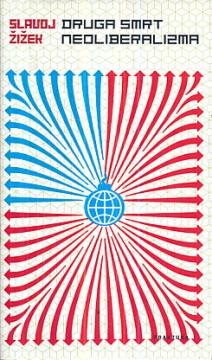
Druga smrt neoliberalizma

Druga smrt neoliberalizma
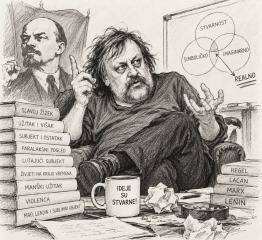
Slavoj Žižek

With numerous theoretical references, parallactic twists, juicy jokes and interpretations of films, we once again have before us good old Žižek in his best form.

The latest book of the "most dangerous philosopher of the West", as he was recently called in the New Republic magazine, starts from the assertion that neoliberalism died in the 21st century at least twice: the first time on September 11, as a political doctrine, and the second time with the financial crisis of 2008. as economic theory. Investigating in detail this second death, the consequences of which we still feel today, Žižek does not dwell only on the criticism of the current state, but also takes a step further. Instead of the false alternative "capitalism or socialism", he chooses - communism! It shows that even the free market can no longer do without the state, and that the only solution is the re-appropriation of "the commons". The fundamental role model here is the rebellious Haitian slaves who took the ideas of the French Revolution more seriously than the French themselves.

Original title
First a tragedy, then as farce
Translation
Srećko Horvat
Editor
Seid Serdarević
Dimensions
21.5 x 12.5 cm
Pages
218
Publisher
Fraktura, Zaprešić, 2009.
 
Latin alphabet. Hardcover with dust jacket.
Language: Croatian.

No copies available

The last copy was sold recently.
 

Are you interested in another book? You can search the offer using our search engine or browse books by category.

You may also be interested in these titles

Irak: posuđeni čajnik

Irak: posuđeni čajnik

Slavoj Žižek
Naklada Ljevak, 2005.
Croatian. Latin alphabet. Paperback.
16.99
Istorija srpske filozofije

Istorija srpske filozofije

Slobodan Žunjić

Slobodan Žunjić, in his book History of Serbian Philosophy, provides a comprehensive overview of the development of Serbian philosophical thought from the Middle Ages to the end of the 20th century. The work covers the period from the literacy of Serbs in

Plato, 2009.
Serbian. Cyrillic alphabet. Paperback.
27.98
Die Frage nach dem Ding

Die Frage nach dem Ding

Martin Heidegger

The Question of Things, a collection of lectures given by Heidegger in 1935/36, deals with the fundamental philosophical question: What is a thing? His starting point is Kant's Critique of Pure Reason, but Heidegger goes further, wanting to clarify the ve

Max Niemeyer Verlag, 1975.
German. Latin alphabet. Hardcover with dust jacket.
24.99
Filozofija ikonoklastike (esejistika)

Filozofija ikonoklastike (esejistika)

Ferid Muhić
Veselin Masleša, 1989.
Serbian. Latin alphabet. Paperback.
3.99
O duhu otvorenosti: dimenzije misaonog nasleđa Radomira Konstantinovića

O duhu otvorenosti: dimenzije misaonog nasleđa Radomira Konstantinovića

The collection is an important contribution to the revitalization of Konstantinović's thought in the post-Yugoslav space, demonstrating that his critique of the rural mind remains relevant for understanding contemporary social and political pathologies.

Gradska biblioteka Subotica, 2016.
Serbian. Latin alphabet. Paperback.
7.325.86
Zanimljiva vremena, nemirna vremena: S Lešekom Kolakovskim razgovarao Zbignjev Mencel

Zanimljiva vremena, nemirna vremena: S Lešekom Kolakovskim razgovarao Zbignjev Mencel

Leszek Kolakowski

A book of interviews in which Kołakowski retrospectively describes his life and intellectual journey through the turbulent 20th century – from pre-war Poland, through Nazi occupation, Stalinism, revisionist Marxism, to exile in the West.

Službeni glasnik, 2009.
Serbian. Cyrillic alphabet. Paperback.
The book consists of two volumes
19.44