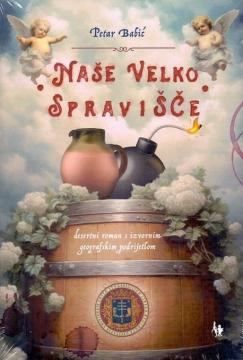
Naše veliko spravišče: desertni roman s izvornim geografskim podrijetlom

Naše veliko spravišče: desertni roman s izvornim geografskim podrijetlom

Petar Babić

Petar Babić's novel Naše velko spravišče was based on a folk theater play, which was based on a legend from the 14th century about the reconciliation of the noble Kalnik peasants Šljivar and the Purgers of Varo.

The core of the play is the famous "Križevački Statutes", and tradition says that the rules were written down just for that occasion during a three-day wine reconciliation, from Friday to Holy Sunday. The act of reconciliation had to be reinforced with two roasted oxen, a gift from the townspeople, and full barrels of local wine, a gift from the noble peasants, and at the same time, a wedding was taking place, constantly on the verge of a mass brawl, of the son of the castellan of Podkalnica, Julček, who was mentally undercapacitated and physically gifted. and daughters of the town judge, tending to the gifted.

With a series of plots, comedic, farcical and grotesque scenes immersed in hectoliters of wine, which helps to clarify the character, unpredictability and tension, all local problems will finally and ironically be solved one drunken night in Krlež, on Vidovdan 1914.

In addition to a fine style that preserves both the authenticity and the archaic layers of the language, Babić equipped the book with several hundred footnotes that are a small encyclopedia of the Križevci region and its prominent people up to the present day, and also added a dictionary of kajkavisisms and graphic attachments and created a unique combination of renovated historical novels and an ethnological collection.

Editor
Kruno Lokotar
Dimensions
24 x 15 cm
Pages
400
Publisher
Jesenski i Turk, Zagreb, 2023.
 
Latin alphabet. Paperback.
Language: Croatian.
ISBN
978-9-53381-007-2

One copy is available

Condition:Unused
 

Are you interested in another book? You can search the offer using our search engine or browse books by category.

You may also be interested in these titles

Orlov dar

Orlov dar

Carlos Castaneda

The sixth book in the series about Castaneda's studies with don Juan Matus, a Yaqui shaman. The novel continues Castaneda's spiritual and philosophical quest, focusing on the concept of the "Eagle's Rule" and the transition to a deeper understanding of sh

BIGZ, 1986.
Croatian. Latin alphabet. Paperback.
4.56
Vetrometine

Vetrometine

Howard Spring

The work rounds out the author's oeuvre and deals with the themes that characterized him: family, personal integrity, moral temptations, social change, and strength of character.

Bratstvo-Jedinstvo, 1965.
Croatian. Latin alphabet. Hardcover with dust jacket.
3.86
Zaljev Chesapeake

Zaljev Chesapeake

James A. Michener

An epic novel that traces the history of the eponymous bay on the east coast of the United States from the 16th century to the 1970s. Through generations of family and historical events, Michener explores man's relationship with nature, social change, and

Globus, 1982.
Croatian. Latin alphabet. Hardcover with dust jacket.
The book consists of two volumes
19.76
Četrdeset pet vitezova, sv. 1-2

Četrdeset pet vitezova, sv. 1-2

Alexandre Dumas

Alexandre Dumas – The Forty-Five Knights, published in 1966, is part of a grand trilogy about the political and religious turmoil in France during the late 16th century.

Epoha, 1966.
Croatian. Latin alphabet. Hardcover with dust jacket.
The book consists of two volumes
9.48
Koraci

Koraci

Jerzy Kosinski

"Steps" is a collection of short stories connected by the character of an unnamed narrator.

Centar za informacije i publicitet (CIP), 1981.
Croatian. Latin alphabet. Hardcover with dust jacket.
2.98
Tri mušketira 1-2

Tri mušketira 1-2

Alexandre Dumas

Dumas' version of the story depicts the adventures of d'Artagnan and his friends from 1625 to 1628.

Epoha, 1966.
Croatian. Latin alphabet. Hardcover with dust jacket.
The book consists of two volumes
9.48