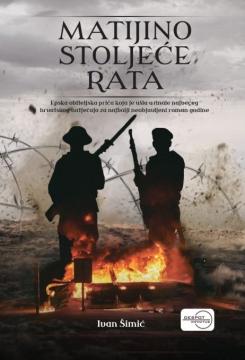
Matijino stoljeće rata

Matijino stoljeće rata

Ivan Šimić

Matija's Century of War is an epic, so Croatian story about the 20th century written in a superior narrative and style, which you will not read, but swallow!

By intertwining fiction and real events, not caring about literary-theoretical laws and rigid genre molds, about which according to his own admission he knows little or nothing anyway, the obviously well-informed author brings testimonies about people and events in a really wide temporal and spatial scope, thus tragic fate convincingly places the titular heroines in the historical context that actually decisively determined that fate. To that extent, this book is simultaneously a Chronique du xxe siècle, as the subtitle suggests, but also a moving story about a woman who survived as many as three wars, losing in each of them one of her closest relatives.

The first chapter - via Imotski, Split and Trieste - takes us on an exciting journey from Herzegovina to New York, where we follow the failed attempt of Matija's father Mata to move to America (this failure is a kind of capstone of a series of later family misfortunes), the second tells about Matina tragic fate in the First World War, from fighting and capture in Galicia to imprisonment in deep Russia, and the third and fourth about the fate of his descendants through two new cataclysms, from Herzegovina in the Second World War to Sarajevo in the last war in the nineties.

Our Matija, the main character of the novel, was born in 1912. That woman's father was killed in the first of her three wars, her husband was killed in the second, and her son and grandson in the third. Matija died in 1995, after all these tragedies through four generations.

Editor
Danijel Tatić
Graphics design
Dražen Štebih
Dimensions
20 x 14 cm
Pages
326
Publisher
Despot Infinitus d.o.o., Zagreb, 2024.
 
Latin alphabet. Paperback.
Language: Croatian.
ISBN
978-9-53366-149-0

One copy is available

Condition:Unused
 

Are you interested in another book? You can search the offer using our search engine or browse books by category.

You may also be interested in these titles

Poslije svega: Melankolija ratnika

Poslije svega: Melankolija ratnika

Janja Jaman

The novel After Everything - The Melancholy of a Warrior by Janja Jaman is a deeply introspective work that, through a blend of reality and fiction, explores the psychological and emotional consequences of the war in Croatia and Bosnia and Herzegovina on

ACCA, 2008.
Croatian. Latin alphabet. Paperback.
8.26
War Is a Force that Gives Us Meaning

War Is a Force that Gives Us Meaning

Chris Hedges

As a veteran war correspondent, Chris Hedges has survived ambushes in Central America, imprisonment in Sudan, and a beating by Saudi military police.

Anchor Book Press, 2003.
English. Latin alphabet. Paperback.
12.6810.14
Tanka crvena crta 1-2

Tanka crvena crta 1-2

James Jones

The Thin Red Line (1962) is a realistic depiction of war through the experiences of soldiers in the Battle of Guadalcanal during World War II. The novel follows Company C of the U.S. Marines in the Pacific in 1942, focusing on their internal struggles und

Globus, 1980.
Croatian. Latin alphabet. Hardcover with dust jacket.
The book consists of two volumes
13.56
Zvižduk

Zvižduk

James Jones

The Whistle (1978), James Jones' final novel, published posthumously, concludes his war trilogy, which began with Here to Eternity and The Thin Red Line. The Whistle is set in the American South during World War II.

Globus, 1980.
Croatian. Latin alphabet. Hardcover with dust jacket.
6.74 - 7.94
The Boat Runner

The Boat Runner

Devin Murphy

In the tradition of All The Light We Cannot See and The Nightingale, comes an incandescent debut novel about a young Dutch man who comes of age during the perilousness of World War II.

HarperCollins Publishers, 2017.
English. Latin alphabet. Paperback.
9.367.49
Sabrana dela Miodraga Bulatovića / 5 - Rat je bio bolji

Sabrana dela Miodraga Bulatovića / 5 - Rat je bio bolji

Miodrag Bulatović

Conceived and realized as a separate unit, this novel can also be interpreted as the second part of the book "A Hero on a Donkey". To a greater extent than in "Hero", here the war "which was better" is presented as a giant burlesque and as a pool of demon

Narodna knjiga, 1984.
Serbian. Latin alphabet. Hardcover.
3.50