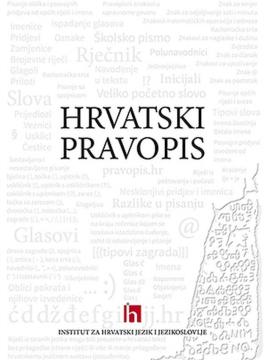
Hrvatski pravopis

Hrvatski pravopis

The Croatian orthography is signed by 14 scientists of the Institute, whose efforts were joined by 400 experts who participated in a month-long public discussion with comments and suggestions and thus contributed to the shaping of the final text.

Croatian spelling consists of spelling rules, notes, explanations, tips, a glossary and an extensive spelling dictionary with 35,000 words. Linguistic tips are attached to the basic text of the spelling, in which language problems are highlighted, in the explanations the authors explain why they preferred a certain version, and in the notes they introduce other permitted versions.

The only spelling in the history of the Croatian language that was created as a result of the work of scientists and public debate, speakers of the Croatian language. Based on the opinion of top experts, the Ministry of Science, Education and Sports recommended the use of this work in primary and secondary schools. The publication also means the end of the many years of chaotic situation in Croatian spelling.

Institute for Croatian Language and Linguistics

The Institute for Croatian Language and Linguistics was founded in 1948 under the auspices of the Croatian Academy of Sciences and Arts. In more than sixty years of its existence, the Institute has changed its name and structure on several occasions, but it has never renounced its fundamental task - caring for the Croatian language and preserving the Croatian linguistic identity. The Institute took care of the Croatian language even in periods when this care was hindered from all sides. Even in the era when the Croatian language could not be called by its true name, the Institute nurtured the Croatian language culture, encouraged the creative development of linguistic theories, systematically studied the Croatian dialect and onomastic heritage, and self-effacingly produced fundamental works of Croatian lexicography and linguistics.

Editor
Željko Jozić
Dimensions
21 x 15 cm
Pages
500
Publisher
Institut za hrvatski jezik i jezikoslovlje, Zagreb, 2024.
 
Latin alphabet. Paperback.
Language: Croatian.
ISBN
978-9-53796-704-8

No copies available

The last copy was sold recently.
 

Are you interested in another book? You can search the offer using our search engine or browse books by category.

You may also be interested in these titles

Englesko-hrvatski i hrvatsko-engleski rječnik

Englesko-hrvatski i hrvatsko-engleski rječnik

Višnja Grahovac, Božica Pavlinek

The bilingual dictionary by Višnja Grahovac and Božica Pavlinek is a practical and comprehensive tool for anyone learning or using English and Croatian, whether for educational, business, or everyday purposes.

Školska knjiga, 2002.
Croatian. Latin alphabet. Paperback.
8.42
Rječnik stranih riječi

Rječnik stranih riječi

Bratoljub Klaić

Bratoljub Klaić, a Croatian scholar, lexicographer and translator (1909 – 1983), gave Croatian lexicography the Dictionary of Foreign Words, which marked the second half of the 20th century in Croatia and the wider region.

Nakladni zavod Matice hrvatske, 1983.
Croatian. Latin alphabet. Hardcover.
13.42
Maslinov vijenac 6

Maslinov vijenac 6

Drago Štambuk

The publication contains verses from poets awarded with the Olive Wreath at the Croatia Rediviva Heritage Days held in Selce on Brač from 2016-2020.

Croatia rediviva, 2021.
Croatian. Latin alphabet. Paperback.
16.84
Semiologija

Semiologija

Pierre Guiraud

Guiraud defines semiology as the science of signs and sign systems. He starts from Saussure's idea that language is the model for the study of all other signs.

Prosveta, 1983.
Serbian. Latin alphabet. Paperback.
4.98
Opšta lingvistika

Opšta lingvistika

Ferdinand de Saussure

The book Opšta lingvistika or General Course in Linguistics (1916, compiled posthumously from the lectures of the Swiss linguist Ferdinand de Saussure, 1857–1913) represents the foundation of structuralism and modern linguistics.

Nolit, 1969.
Serbian. Latin alphabet. Paperback.
9.34
Hrvatski naš svagda(š)nji

Hrvatski naš svagda(š)nji

Stjepko Težak

Words are like people: they are born, grow, travel, cross the borders of municipalities, provinces and states, adapt, change nationality and citizenship, reproduce, age and die, and – unlike people, similar to gods – they can also be resurrected.

Školske novine, 1990.
Croatian. Latin alphabet. Hardcover.
4.24