Šarmeri bez pokrića

Šarmeri bez pokrića

Pero Zlatar

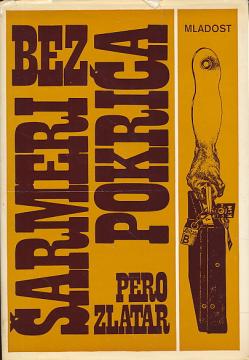
Charmers Without a Cover is a romanticized chronicle of Yugoslav society from the mid-1950s to the mid-1970s. Through the character of a journalist tasked with following the so-called "jet set", Zlatar depicts the world of tabloids, film, television, spor

The main character, a journalist, describes how he was tasked with following the type of people who, in our times, try to imitate the so-called jet set: the world of the tabloid press (stars and star-makers!), the world of film – especially from the era of film co-productions in our country – and partly people from television, athletes, singers, our export celluloid beauties, Italian hunters and merchants, festival "butterflies", models, photo models...

The book explores how individuals created the illusion of importance, wealth and influence, while behind that facade there were often lies and manipulations. Through the personal experiences of the main character, Zlatar shows how the world of the famous and famous is attractive, but also dangerous, and how many journalists and public figures succumbed to its charms.

Charmers Without a Cover is a work that offers insight into social changes and the emergence of a new elite in the former Yugoslavia, and critically reflects on the superficiality and false glamour of public life.

Editor
Alojz Majetić
Graphics design
Fadil Vejzović
Dimensions
20 x 14 cm
Pages
347
Publisher
Mladost, Zagreb, 1978.
 
Latin alphabet. Hardcover with dust jacket.
Language: Croatian.

Two copies are available

Copy number 1

Condition:Used, very good condition
Damages or inconvenience notice:
  • Damaged book cover

Copy number 2

Condition:Used, very good condition
Damages or inconvenience notice:
  • Slight damage to the dust jacket
 

Are you interested in another book? You can search the offer using our search engine or browse books by category.

You may also be interested in these titles

Bitange mirno !

Bitange mirno !

Pero Zlatar
Mladinska knjiga, 1990.
Croatian. Latin alphabet. Paperback.
5.67
Vežite se, slijećemo

Vežite se, slijećemo

Pero Zlatar
Centar za informacije i publicitet (CIP), 1975.
Croatian. Latin alphabet. Hardcover with dust jacket.
6.78 - 7.48
Medvjed u zelenoj bundi

Medvjed u zelenoj bundi

Pero Zlatar
Mladost, 1981.
Croatian. Latin alphabet. Hardcover.
4.88
Tanga boy

Tanga boy

Hrvoje Kovačević

Beljo erhielt posthum den lebhaften Spitznamen Tanga Boy. Er rannte mit einem Messer im Bauch, nur mit Tanga-Slips bekleidet und als Katze verkleidet, aus der Wohnung im vierten Stock.

Znanje, 2008.
Croatian. Latin alphabet. Hardcover.
5.98
Stranac

Stranac

Albert Camus

„Der Fremde“ ist der Roman, mit dem Camus seinen ersten großen Erfolg erzielte, beeinflusst von Nietzsches Philosophie, Sartres Philosophie des Existentialismus und vor allem seiner Philosophie des Absurden.

Globus, 2004.
Croatian. Latin alphabet. Hardcover with dust jacket.
6.38 - 6.42
Kornel večernji

Kornel večernji

Deszo Kosztolanyi

Deze Kostolanyi ist ein außergewöhnlicher ungarischer Künstler, der ursprünglich aus Subotica stammt und in vielen literarischen Genres Erfolg hatte, von der Poesie über Essays bis hin zu Theaterstücken.

Dereta, 1999.
Serbian. Cyrillic alphabet. Paperback.
8.28