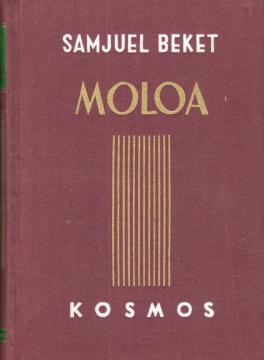
Moloa

Moloa

Samuel Beckett

The novel Molloy (1951) is the first part of Beckett's famous trilogy, along with Malone Dies and The Nameless. It is structured in two parts, each told from the perspective of a different narrator: first Molloy, then Jacques Moran.

In the first part, Molloy, old and physically frail, writes from his mother's room, with no memory of how he got there. He recalls a journey in search of his mother, during which he meets various characters and gets into absurd situations. His daily life is marked by bizarre habits, such as the ritualistic movement of pebbles in his pockets, which symbolizes his need for order in a chaotic world.

The second part follows Moran, a detective sent by his superior Gaber to find Molloy. Moran, initially organized and disciplined, gradually loses control of himself and his mission. His journey becomes introspective, and his transformation reflects the fundamental themes of the novel: the loss of identity and the meaninglessness of the human search for meaning.

Through Molloy, Beckett explores existential themes such as identity, memory, and the absurdity of existence. The novel is known for its experimental style, long monologues, and fragmented narration, which further emphasizes the sense of disorientation and meaninglessness.

Molloy is a key text of modernist literature and a significant contribution to the philosophy of existentialism, inviting the reader to reflect on the nature of existence and identity.

Original title
Molloy
Translation
Kaća Samardžić
Editor
Radomir Konstantinović
Graphics design
Mih. S. Petrov
Dimensions
20 x 14 cm
Pages
296
Publisher
Kosmos, Beograd, 1959.
 
Latin alphabet. Hardcover.
Language: Serbian.

One copy is available

Condition:Used, excellent condition
 

Are you interested in another book? You can search the offer using our search engine or browse books by category.

You may also be interested in these titles

Više nego ljudski

Više nego ljudski

Teodor Sterdžen

"More Than Human" is Sturgeon's masterpiece and one of the classic works of SF.

Jugoslavija, 1968.
Serbian. Latin alphabet. Hardcover.
3.98
Najljuća jela tatarske kuhinje

Najljuća jela tatarske kuhinje

Alina Bronsky

The main character, Rosa Ahmetovna, is an extremely self-centered, intrusive, tactless, sly and cunning narrator in this family saga by the author of the acclaimed novel "Scherbenpark" Alina Bronsky.

Naklada Ljevak, 2014.
Croatian. Latin alphabet. Paperback.
21.34
Virusi

Virusi

Borivoj Radaković

"Viruses" is a novel about the intimacy of a fifty-year-old, about marriage, relationships between people, love, work, erotica, art... against disease, death, violence, politics, war.

Europapress holding, 2005.
Croatian. Latin alphabet. Paperback.
3.88
Sveučilišna obala

Sveučilišna obala

Genadiji Gor
Znanje, 1966.
Croatian. Latin alphabet. Hardcover with dust jacket.
4.98
Put u visoko društvo

Put u visoko društvo

John Braine
Naprijed, 1960.
Croatian. Latin alphabet. Hardcover with dust jacket.
3.22
Kalfa

Kalfa

Irfan Horozović
Svjetlost, 1988.
Croatian. Latin alphabet. Hardcover with dust jacket.
5.99