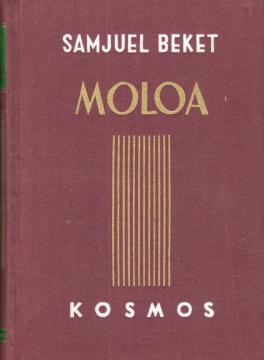
Moloa

Moloa

Samuel Beckett

The novel Molloy (1951) is the first part of Beckett's famous trilogy, along with Malone Dies and The Nameless. It is structured in two parts, each told from the perspective of a different narrator: first Molloy, then Jacques Moran.

In the first part, Molloy, old and physically frail, writes from his mother's room, with no memory of how he got there. He recalls a journey in search of his mother, during which he meets various characters and gets into absurd situations. His daily life is marked by bizarre habits, such as the ritualistic movement of pebbles in his pockets, which symbolizes his need for order in a chaotic world.

The second part follows Moran, a detective sent by his superior Gaber to find Molloy. Moran, initially organized and disciplined, gradually loses control of himself and his mission. His journey becomes introspective, and his transformation reflects the fundamental themes of the novel: the loss of identity and the meaninglessness of the human search for meaning.

Through Molloy, Beckett explores existential themes such as identity, memory, and the absurdity of existence. The novel is known for its experimental style, long monologues, and fragmented narration, which further emphasizes the sense of disorientation and meaninglessness.

Molloy is a key text of modernist literature and a significant contribution to the philosophy of existentialism, inviting the reader to reflect on the nature of existence and identity.

Naslov izvornika
Molloy
Prijevod
Kaća Samardžić
Urednik
Radomir Konstantinović
Naslovnica
Mih. S. Petrov
Dimenzije
20 x 14 cm
Broj strana
296
Nakladnik
Kosmos, Beograd, 1959.
 
Latinica. Tvrde korice.
Jezik: Srpski.

Jedan primjerak je u ponudi

Stanje:Korišteno, u odličnom stanju
Dodano u košaricu!
 

Zanima Vas i neka druga knjiga? Možete pretražiti našu ponudu pomoću tražilice ili prelistati knjige po kategorijama.

Možda će Vas zanimati i ovi naslovi

Triologija: Molloy, Malone umire, Neimenjivi

Triologija: Molloy, Malone umire, Neimenjivi

Samuel Beckett

He has marked the contemporary era like few others, and his heroes or "heroes" with their emotional and moral dilemmas, weighed down by existential anxiety and news of cataclysms and possible apocalypses, are closer to us than ever.

Šareni dućan, 2014.
Hrvatski. Latinica. Tvrde korice.
29,38
Proces

Proces

Franz Kafka

Kafka wrote The Process between 1914 and 1915, published posthumously in 1925. The novel is unfinished but with an added final chapter by Max Brod. Edition with a foreword by B. Živojinović and an afterword by Walter Killi.

BIGZ, 1990.
Srpski. Latinica. Broširano.
4,26
Deobe 1-3

Deobe 1-3

Dobrica Ćosić

This work, awarded the NIN Prize for that year, is considered one of the most significant in Serbian literature after World War II.

Prosveta, 1961.
Srpski. Ćirilica. Tvrde korice s ovitkom.
Knjiga se sastoji od tri toma
11,42
Crna kutija

Crna kutija

Amos Oz

The Black Box is a kaleidoscope of married life and love relationships. It is a novel that implicitly speaks about all of us.

Hena Com, 2001.
Hrvatski. Latinica. Tvrde korice.
10,98
Pripovetke iz levog i desnog džepa

Pripovetke iz levog i desnog džepa

Karel Čapek

These stories deal with different topics, although most deal with different criminal acts, from fraud and fortune-telling to marriage fraud and murder.

Jugoslavijapublik, 1980.
Hrvatski. Latinica. Tvrde korice.
5,22
Rudnik čvaraka

Rudnik čvaraka

Tomislav Šovagović

The debut work of Croatian writer Tomislav Šovagović, awarded the Josip and Ivan Kozarac Award in 2012, is a dedication to Slavonia – the region of his childhood that the author, born in Dalmatia, observes with foreign but tender eyes.

Mozaik knjiga, 20112.
Hrvatski. Latinica. Broširano.
11,56