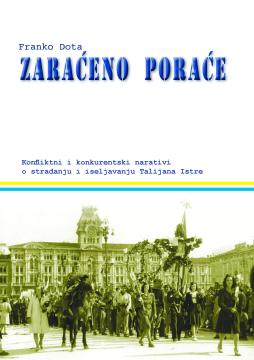
Zaraćeno poraće: Konfliktni i konkurentski narativi o stradanju i iseljavanju Talijana Istre

Zaraćeno poraće: Konfliktni i konkurentski narativi o stradanju i iseljavanju Talijana Istre

Franko Dota

The book analyzes how conflicting historical narratives about the suffering and mass emigration of Italians from Istria and Rijeka developed in Croatia and Italy after World War II (1943–1956), debunking myths and encouraging an empathetic approach to the

The author compares Italian historiography, which emphasizes the “foibe” (mass murders in karst pits) and the “Istrian egozodus” as ethnic cleansing, with Yugoslav/Croatian historiography, which has long tabooed these events, presenting them as “liberation” from fascism or the result of “people’s justice”.

Dota divides the analysis into two phases: 1945–1990, where in Yugoslavia the topic was suppressed and in Italy politicized for revisionism; and after the 1990s, when Croatian historiography begins to critically examine, but still struggles with, national myths. He uses primary sources (documents, memoirs, newspaper articles) and juxtaposes texts to show ideological structures: Italian narratives use sacrificial rhetoric for national cohesion, while Croatian ones move from denial to recognition, but with a focus on the anti-fascist context.

Key examples are the mystification of “fobes” (e.g. the number of victims: from 5,000 to 20,000) and accusations of “genocide”. The book is not only a historiographical synthesis, but also a contribution to the culture of remembrance: it calls for a dialogue between narratives in order to understand that the emigration (up to 350,000 Italians) was a consequence of war, but also of political decisions (the Peace of Paris in 1947).

Graphics design
Krešimir Krnić
Dimensions
23.5 x 16.5 cm
Pages
149
Publisher
Srednja Europa, Zagreb, 2010.
 
Latin alphabet. Paperback.
Language: Croatian.
ISBN
978-9-53697-974-5

One copy is available

Condition:Used, excellent condition
 

Are you interested in another book? You can search the offer using our search engine or browse books by category.

You may also be interested in these titles

Genocid u srednjem Podrinju 1992.-1995.

Genocid u srednjem Podrinju 1992.-1995.

Velid Šabić

The book Genocide in the Central Podrinje 1992-1995. by Velid Šabić presents a thorough scientific analysis of the crimes committed against the Bosniak population in the middle Podrinje region during the war in Bosnia and Herzegovina.

Institut za istraživanje zločina protiv čovječnosti i međunarodnog prava Univerziteta u Sarajevu, 2008.
Croatian. Latin alphabet. Paperback.
12.36
Nevidljivi neprijatelj na Atlantiku 1-2

Nevidljivi neprijatelj na Atlantiku 1-2

Boris Prikril

The book provides a detailed account of naval conflicts in the Atlantic Ocean during World War II, with particular emphasis on the Battle of the Atlantic Convoy and the activities of German submarines – the so-called "invisible enemy".

Znanje, 1985.
Croatian. Latin alphabet. Hardcover with dust jacket.
The book consists of two volumes
6.98
Dizanje prošlosti u vazduh: Ogledi o Balkanu i Istočnoj Evropi

Dizanje prošlosti u vazduh: Ogledi o Balkanu i Istočnoj Evropi

Marija Todorova

A collection of essays by the Bulgarian historian Maria Todorova (known for Imaginary Balkans), compiled especially for the 20th Century Library. Indispensable for understanding post-communist transitions, culture of memory and Balkan studies.

Biblioteka XX vek, 2010.
Serbian. Latin alphabet. Paperback.
8.44
Projekt Guevara: Snovitim stazama svjetske revolucije

Projekt Guevara: Snovitim stazama svjetske revolucije

Gerd Koenen

This book is a biography of the historical figure and icon of the twentieth century, Ernesto Che Guevara - in light of his project of a world revolution, which Koenen, after Bruce Chatwin, will call dream paths.

Durieux, 2011.
Croatian. Latin alphabet. Hardcover with dust jacket.
17.62
Radni logor Valpovo 1945.-1946.: dokumenti

Radni logor Valpovo 1945.-1946.: dokumenti

Vladimir Geiger

The Valpovo labor camp (1945–1946) was the largest camp for Volksdeutschers in Croatia after World War II. About 4,000 Germans and Austrians were interned; at least 1,074 died, mostly from hunger, disease, and exhausting labor.

Njemačka zajednica podunavskih Švaba u Hrvatskoj, 1999.
Croatian. Latin alphabet. Hardcover.
27.34