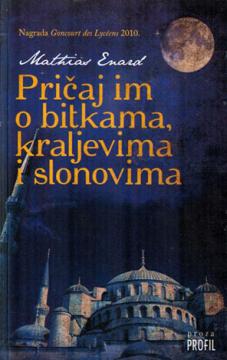
Pričaj im o bitkama, kraljevima i slonovima

Pričaj im o bitkama, kraljevima i slonovima

Mathias Énard

In 1506, Michelangelo Buonarroti was invited by Sultan Bayezid II to design a bridge across the Golden Horn in Constantinople. Furious at Pope Julius II who had humiliated him and refused to pay, Michelangelo left Rome and arrived by ship in Constantinopl

In the city of two faiths and three continents, the artist encounters a completely different world: the scents of spices, hammams, court intrigues, poets singing in Persian, Armenian dancers, and a mysterious courtesan whose body is “like an unreadable script.” He falls in love with her (or with him?), and love becomes an obsession as dangerous as the political games between the Ottoman Empire and Christian Europe.

Michelangelo will never build that bridge (history records that the project failed), but in Constantinople he will find a new language of form, eroticism, and solitude. Énard masterfully interweaves real historical facts with fiction: he contrasts the melancholy of a Renaissance genius with the opulence of the Orient and shows how East and West are reflected in each other – attracting and repelling.

A short, dense novel about art born of exile, about love that knows no gender, and about bridges that remain only in dreams.

Original title
Parle-leur de batailles, de rois et d'éléphants
Translation
Mia Pervan
Editor
Roman Simić Bodrožić
Dimensions
19 x 12 cm
Pages
161
Publisher
Profil Knjiga, Zagreb, 2012.
 
Latin alphabet. Paperback.
Language: Croatian.
ISBN
978-9-53313-119-1

Two copies are available

Copy number 1

Condition:Used, excellent condition

Copy number 2

Condition:Used, excellent condition
Discounted price: 7.465.60
25% discount is valid until 9/1/26 11:59 pm
 

Are you interested in another book? You can search the offer using our search engine or browse books by category.

You may also be interested in these titles

Pariški pokolj

Pariški pokolj

Jean Cassou
Naklada Binoza, 1936.
Croatian. Latin alphabet. Hardcover with dust jacket.
19.74 - 21.46
Evgenija Grande / Muzej starina

Evgenija Grande / Muzej starina

Honore de Balzac

In his novels Eugenie Grandet (1833) and The Museum of Antiquities (1837), Balzac explores universal themes of greed, human passions, sacrifice, and moral dilemmas, placing them in different social contexts of 19th-century French society.

Svjetlost, 1963.
Croatian. Latin alphabet. Hardcover.
3.48
Tartarinova trilogija

Tartarinova trilogija

Alphonse Daudet
Novo pokolenje, 1948.
Croatian. Latin alphabet. Hardcover with dust jacket.
2.28 - 9.12
Talijanske kronike

Talijanske kronike

Marie-Henry Beyle Stendhal

Flipping through old Italian chronicles, Stendhal finds motifs for a series of his novels in which he depicts the passions of the Middle Ages and the unrestrained madness of the Renaissance.

Matica hrvatska, 1948.
Croatian. Latin alphabet. Hardcover with dust jacket.
9.36
Ljubičice u srijedu

Ljubičice u srijedu

Andre Maurois

André Maurois, a French writer known for his psychological novels and biographies, explores themes of family relationships, love, and internal conflicts in this work, which is characteristic of his style.

Svjetlost, 1965.
Croatian. Latin alphabet. Paperback.
3.42 - 3.62
Eugenija Grande

Eugenija Grande

Honore de Balzac

"Eugénie Grandet" (1833), part of Balzac's Human Comedy, is a realistic novel that explores greed, family relationships, and the sacrifices of love in provincial French society.

Svjetlost, 1981.
Croatian. Latin alphabet. Hardcover.
3.88