Kopernikanska mobilizacija i ptolomejsko razoružanje: Ogled iz estetike
Rare book

Kopernikanska mobilizacija i ptolomejsko razoružanje: Ogled iz estetike
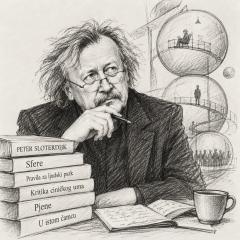
Peter Sloterdijk

In this provocative essay, Sloterdijk intervenes in the heated debate of the 1980s about modernism and postmodernism. A short, sharp text – essential for understanding Sloterdijk's early approach to aesthetics, media and the crisis of modernity.

Sloterdijk uses the metaphor of astronomical models to describe the fate of aesthetics in the modern age. Copernican mobilization means the radical dynamization of the world brought about by modern science and technology: Copernicus' heliocentric turn (the Earth is not the center) extends to all spheres - from physics to culture. Man loses his privileged place in the cosmos, the world becomes infinitely mobile, relativized, without fixed landmarks. Aesthetics can no longer rest on classical, "Ptolemaic" self-evidents (harmony, proportion, centered subject, stable beauty). Instead, modern art and aesthetics enter a permanent mobilization: constant innovations, deconstructions, experiments, loss of support - all under the pressure of scientific and technical progress that "mobilizes" man and art in endless movement.

In response to this destabilization, Ptolemaic disarmament emerges – a postmodern return to the “reliable-deceptive” Ptolemaic truths: re-centering, local perspectives, the illusion of stability, an aesthetic that prefers illusion, decoration, simulation, to profound truth. Sloterdijk sees this as a strategic disarmament – ​​a relinquishment of Copernican tension, a return to the geocentric “comfort” of perception, where aesthetics once again relies on the illusion of center, symmetry, and the familiar.

The essay is not just a critique of postmodernity, but a diagnosis: modernity is inevitably mobilized, but the postmodern attempt at “Ptolemaic” appeasement remains an illusion – it does not restore the lost centering, but only masks the disorientation. Sloterdijk proposes an aesthetic that embraces this duality without escape.

Original title
Kopernikanische Mobilmachung und ptolemäische Abrüstung. Ästhetischer Versuch
Translation
Zlatko Krasni
Dimensions
17 x 12 cm
Pages
87
Publisher
Svetovi, Novi Sad, 1988.
 
Latin alphabet. Paperback with dust jacket.
Language: Serbian.

One copy is available

Condition:Used, very good condition
Damages or inconvenience notice:
  • Pen/marker notes
 

Are you interested in another book? You can search the offer using our search engine or browse books by category.

You may also be interested in these titles

Znamenovanje ruske revolucije

Znamenovanje ruske revolucije

Lav N. Tolstoj

Tolstoy interprets the 1905 revolution as a moral upheaval: violence does not bring justice, but a new yoke. He sees lasting liberation in personal conscience, non-violence and Christian love, not in the state and coercion.

St. Kugli, 1907.
Croatian. Latin alphabet. Hardcover.
17.24
Rajski brežuljci: Povijest moći i nemoći

Rajski brežuljci: Povijest moći i nemoći

Mineke Schipper

In her book, Mineke Schipper explores cultures throughout history to describe the complex relationship men have with the female body. Despite the symbiotic relationship between the sexes, men have always had greater power than women, and at the root of it

Durieux, 2021.
Croatian. Latin alphabet. Hardcover with dust jacket.
16.54
Head in the Stars – Essays on Science Fiction

Head in the Stars – Essays on Science Fiction

Stephen Zepke

A collection of essays on science fiction that explores its philosophical, cultural, and artistic dimensions and its influence on contemporary thought and popular culture.

Multimedijalni institut, 2020.
English. Latin alphabet. Paperback.
12.42
Filozofija kao sistem?

Filozofija kao sistem?

Branko Despot

"Philosophy as a System?" (1999) is a collection of four philosophical lectures by Croatian philosopher Branko Despot (b. 1942), known for his profound interpretations of classical German philosophy and metaphysics.

Hrvatsko filozofsko društvo, 1999.
Croatian. Latin alphabet. Paperback.
11.32
Pjesnik govori: filozofsko-estetske kozerije

Pjesnik govori: filozofsko-estetske kozerije

Drago Ćepulić

"The Poet Speaks: Philosophical-Aesthetic Riddles" by Dragutin (Drago) Ćepulić is a collection of short, thoughtful essays in which the author reflects on literature, art, philosophy, and human creativity in a witty, insightful, and unobtrusive manner.

Minerva nakladna knjižara, 1943.
Croatian. Latin alphabet. Paperback.
6.24
Zamke pristojnosti: Eseji o feminizmu i popularnoj kulturi

Zamke pristojnosti: Eseji o feminizmu i popularnoj kulturi

Maša Grdešić

The Traps of Decency is an inspired blend of erudition and warmth, feminist angst and vulnerability. Reading the book, we feel that we are guided through the challenges of capitalist and patriarchal everyday life by a safe hand, which writes a book that c

Fraktura, 2020.
Croatian. Latin alphabet. Hardcover with dust jacket.
14.36