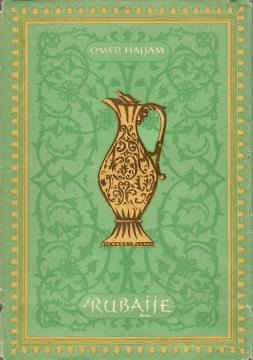
Rubaije
The Rubaiyat (quatrains, rubāʿiyāt) of Omar Khayyam (1048–1131), a Persian mathematician, astronomer, philosopher, and poet from Nishapur, are one of the most influential collections of world poetry.
Originally, there was no fixed canon – 100–1000+ rubaiyats are attributed to him, of which probably around 200–300 are authentic. They are best known thanks to the English translation by Edward Fitzgerald (1859), who freely adapted and popularized Khayyam in the West, and in the Croatian context there are translations by Safvet-beg Bašagić, Fehim Bajraktarević, Mirza Safet and others.
A rubaiyat is a short, strictly structured poem of four verses (quatrains), with the rhyme AABA (the first, second and fourth verses rhyme, the third usually does not). A concise, lapidary, maximally condensed thought.
Main themes and philosophy:
- The transience of life – everything is transient: youth, beauty, power, wealth. Time is merciless (e.g. the Behrama palace became a ruin for wild beasts).
- Pleasure and carpe diem – enjoy the present moment: wine, love, friendship, nature. Wine is a frequent metaphor for ecstasy, oblivion and mystical enlightenment (not just alcohol).
- Skepticism and agnosticism – Khayyam questions the meaning of existence, God's justice, the afterlife. Why suffering? Why death? God is unfathomable, the universe mechanical (fate as a potter's wheel).
- Love and eroticism – sensual, but also spiritual; woman and wine as symbols of transcendence.
- Irony and resignation – man is a puppet in the hands of fate, a cosmic joke; nevertheless, dignity lies in lucidity and enjoyment of the transient.
Khayyam is not a Sufi mystic (like Rumi), but a rational skeptic with a hedonistic emphasis – more existential than romantic spirituality. Fitzgerald's translation has intensified the fatalistic and wine-drinking tone, making him "a poet of wine and doubt".
In Croatian editions (e.g. Bašagić's translation, or 20th-century selections) the rubaiyats sound archaic, but powerful: short pieces of wisdom about life, death, and meaninglessness, interwoven with humor, cynicism, and a deep longing for meaning in a meaningless universe.
The key message of Khayyam's Rubaiyats is: Live now, for tomorrow may not come; drink from the cup of life while you can, for the potter of fate is already shaping a new vessel from your dust.
No copies available
The last copy was sold recently.