Ženski bullyng

Ženski bullyng

Rachel Simmons

The hidden culture of girl-on-girl aggression

The silence on hidden aggression by girls against girls has finally ended. Now is the time to end the silence on an important topic – writes Rachel Simmons in the introduction to her book “Female Bullying” – the hidden culture of aggression by girls against girls, in which bullying is epidemic, exists and is specific and destructive. This epidemic is not characterized by overt physical and verbal behavior, their aggression is channeled into non-physical, indirect and covert forms. Girls use slander, exclusion, gossip, derogatory nicknames and manipulation to inflict psychological pain on their chosen victims. Girls often carry out attacks in tightly woven networks of friendships, which makes their aggression even harder to identify, and the damage it leaves on the victims is only increased. In this culture of aggression, girls fight with body language and sophisticated relationships, instead of fists or knives. In this world, friendship is a weapon, and the sting of someone’s exclamation pales in comparison to a whole day of someone’s silence. There is no gesture more destructive than turning your back on yourself. In a hidden culture of aggression, anger is rarely articulated, and every day at school can be a new social minefield that reactivates without warning. During periods of conflict, girls will turn on each other with a language and a justice that only they understand. Behind the facade of female intimacy lies a territory traveled in secret: marked by anxiety and fueled by silence.

Original title
Odd girl out
Translation
Luka Bekavac
Editor
Nenad Rizvanović
Dimensions
23.5 x 15.5 cm
Pages
279
Publisher
VBZ, Zagreb, 2005.
 
Latin alphabet. Paperback.
Language: Croatian.

One copy is available

Condition:Used, excellent condition
 

Are you interested in another book? You can search the offer using our search engine or browse books by category.

You may also be interested in these titles

Kraj siromaštva: Ekonomske mogućnosti našeg doba

Kraj siromaštva: Ekonomske mogućnosti našeg doba

Jeffrey Sachs

In the book, economist Jeffrey Sachs presents an optimistic plan for eliminating extreme poverty by 2025. He argues that this is feasible with political will, because world wealth is growing, and poverty is not fate, but the result of inefficient systems.

Algoritam, 2007.
Croatian. Latin alphabet. Paperback.
9.78
Rajski brežuljci: Povijest moći i nemoći

Rajski brežuljci: Povijest moći i nemoći

Mineke Schipper

In her book, Mineke Schipper explores cultures throughout history to describe the complex relationship men have with the female body. Despite the symbiotic relationship between the sexes, men have always had greater power than women, and at the root of it

Durieux, 2021.
Croatian. Latin alphabet. Hardcover with dust jacket.
16.54
Grad sunca

Grad sunca

Tommaso Campanella

The City of the Sun (Latin: Civitas Solis, published in 1623) is a visionary, esoteric, almost mystical utopia, deeply imbued with the Renaissance spirit, Egyptian astrology, and the Christian hope for a perfect society.

Kultura, 1964.
Serbian. Latin alphabet. Hardcover.
7.52
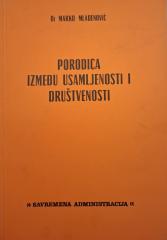
Porodica između usamljenosti i društvenosti

Porodica između usamljenosti i društvenosti

Marko Mladenović

The work analyzes the function of the family as a fundamental social community, its transformations, and the tension between individualism and togetherness within family relationships.

Savremena administracija, 1976.
Serbian. Latin alphabet. Paperback.
4.98
Ljudska povijest emocija: Kako su naši osjećaji sagradili svijet kakav poznajemo

Ljudska povijest emocija: Kako su naši osjećaji sagradili svijet kakav poznajemo

Richard Firth-Godbehere

In this provocative and interdisciplinary book, the author shows that emotions are not universal biological constants, but change across time, cultures, and social contexts – and they are precisely those that are crucial in shaping the history of humanity

Školska knjiga, 2023.
Croatian. Latin alphabet. Hardcover with dust jacket.
21.36
Politika simbola

Politika simbola

Ivan Čolović

The essays collected in this book are inspired by the idea that politics is largely a matter of symbols.

Biblioteka XX vek, 2000.
Serbian. Latin alphabet. Paperback.
9.64