Magarcima pucaju rebra: Zapisi varoškog skribe

Magarcima pucaju rebra: Zapisi varoškog skribe

Leo Držić

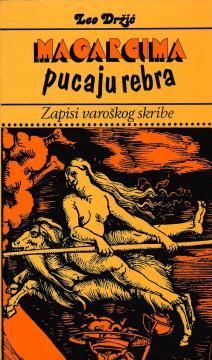
In the novel Donkeys' Ribs Are Cracking - The Notes of a Town Scribe, Leo Držić humorously brings 17th-century Zagreb to life through the notes of clerk Dominik Pivarić. Through the conflicts between Gradec and Kaptol, a satirical chronicle of power, pett

Donkeys' Ribs Are Cracking by Leа Držić is a chronicle of old Zagreb from the 17th century, presented through the eyes of the town clerk Dominik Pivarić. The title, taken from the proverb "When horses kick, donkeys' ribs are cracking", metaphorically describes the position of "little people" in a society where the conflict between the powerful always breaks out on the weaker.

The novel combines historical facts, satire and lively humor, creating a vivid mosaic of the conflict between Gradec and Kaptol - two worlds divided by religion, power and interests. Through the everyday events of a magistrate, Držić depicts Zagreb at that time as a place of misunderstanding, intrigue and struggle for prestige, in which ordinary citizens suffer the consequences of other people's ambitions.

Although set in the past, the work has a contemporary tone: written in today's language, it refreshes the spirit of the times and actualizes the themes of moral duplicity, the relationship between the individual and the system, the struggle between power and common sense.

In addition to the title chronicle, the book also contains the prose "Head Against the Wall", which motivically continues and rounds out the story of the human search for dignity in the world of the powerful. The result is a humorous, insightful and warmly written book that confirms Držić as a master of subtle satire and irony.

Editor
Zlatko Crnković
Graphics design
Alfred Pal
Dimensions
20 x 12 cm
Pages
156
Publisher
Znanje, Zagreb, 1980.
 
Latin alphabet. Paperback.
Language: Croatian.

One copy is available

Condition:Used, excellent condition
 

Are you interested in another book? You can search the offer using our search engine or browse books by category.

You may also be interested in these titles

Hrvatske narodne pjesme VI.: Ženske pjesme II. Pričalice i lakrdije

Hrvatske narodne pjesme VI.: Ženske pjesme II. Pričalice i lakrdije

The sixth volume of the famous Matica Hrvatska edition, edited in 1914 by Dr. Nikola Andrić (1867–1942), is a collection of humorous, satirical and humorous women's folk songs (tales and farces).

Matica hrvatska, 1914.
Croatian. Latin alphabet. Paperback.
15.26
Gjurkovićeve kćeri

Gjurkovićeve kćeri

Ferenc Herczeg

"The Gjurković Daughters" (1893) by Ferenc Herczeg (1863–1954) is a humorous novel about the adventures, loves, and everyday life of three lively daughters of the Hungarian noble Gjurković family.

Narodna knjižnica, 1919.
Croatian. Latin alphabet. Paperback.
7.36
Tri lopova (Moj stric milijarder): Roman premodernih običaja

Tri lopova (Moj stric milijarder): Roman premodernih običaja

Umberto Notari

Three Thieves is a satirical novel about three thieves of different levels — from a petty thief to a prominent financial manipulator. A witty critique of society, morality, and capitalism with the subtitle "My Billionaire Uncle."

Moderna knjižnica, 1919.
Croatian. Latin alphabet. Hardcover.
8.46
Uloga moje porodice u svetskoj revoluciji

Uloga moje porodice u svetskoj revoluciji

Bora Ćosić

The boy Bora tells the story of a chaotic family in Belgrade during the war and the post-war revolution. Mom, dad, grandfather, uncle and aunts live an absurd everyday life full of laughter, chaos and irony, while the "world revolution" enters their apart

Znanje, 1987.
Serbian. Latin alphabet. Paperback.
8.42
Ja nisam Švabo

Ja nisam Švabo

Vedran Kukavica

A novel about identity, Dalmatia that cannot see the sea, establishing paternity, and pumpkin soup, "I Am Not a Švabo" is the debut novel by television journalist, economic commentator, and writer Vedran Kukavica.

Profil Knjiga, 2016.
Croatian. Latin alphabet. Paperback.
13.14
Cirkus broj XX

Cirkus broj XX

Franjo Domović

In the collection "Circus Number XX", Franjo Domović brings satire, humorous and cheeky poems in which he comments on society, bohemian life and human weaknesses with irony and a comic-tragic tone.

Knjižara i papirnica Zaklinčić i Ujčić, 1924.
Croatian. Latin alphabet. Paperback.
8.32