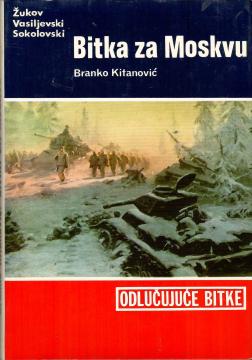
Bitka za Moskvu

Bitka za Moskvu

Branko Kitanović

The Battle of Moscow is a historical account of the German Operation "Barbarossa", the Soviet defense and counteroffensive in 1941. The author, with the testimonies of the top Soviet military leaders, shows how the first German defeat in the war unfolded.

The Battle of Moscow by Branko Kitanović is a detailed historical study of one of the key battles of World War II, based on the testimonies of the most important Soviet commanders – Zhukov, Rokossovsky, Sokolovsky, Vasilevsky, Konev and others. Kitanović chronologically presents the course of Operation Barbarossa, German expectations and misconceptions, the rapid breakthrough of the Wehrmacht and the initial chaos and enormous losses of the Red Army.

The decisive relocation of Soviet industry to the east, the mobilization of Moscow into a “city in a greatcoat” and the beginning of Operation Typhoon, the German attempt to take the capital in a flash, are particularly depicted. With the entry of Marshal Georgy Zhukov into command, the defense gains organized solidity, and the German attack gradually loses momentum due to winter, exhaustion and Soviet resistance.

The climax of the book is the description of the great Soviet counteroffensive on December 6, 1941, when thousands of guns, Katyushas and hundreds of aircraft crush German positions. The Wehrmacht's first major defeat marked the end of the myth of their invincibility and had a huge international resonance, announcing a turning point in the war.

Kitanović's account combines documentary, military analysis, and participant testimony, making The Battle of Moscow an accessible, clear, and powerful work about one of the most decisive moments in modern history.

Dimensions
20 x 14 cm
Pages
155
Publisher
Alfa, Zagreb, 1975.
 
Latin alphabet. Hardcover with dust jacket.
Language: Croatian.

One copy is available

Condition:Unused
 

Are you interested in another book? You can search the offer using our search engine or browse books by category.

You may also be interested in these titles

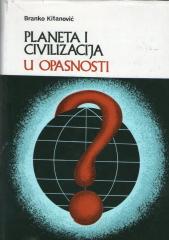
Planeta i civilizacija u opasnosti

Planeta i civilizacija u opasnosti

Branko Kitanović
Privredna štampa, 1979.
Serbian. Latin alphabet. Hardcover with dust jacket.
4.99
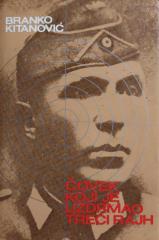
Čovek koji je uzdrmao Treći rajh

Čovek koji je uzdrmao Treći rajh

Branko Kitanović
Veljko Vlahović.
Serbian. Latin alphabet. Hardcover with dust jacket.
8.14
Projekt Guevara: Snovitim stazama svjetske revolucije

Projekt Guevara: Snovitim stazama svjetske revolucije

Gerd Koenen

This book is a biography of the historical figure and icon of the twentieth century, Ernesto Che Guevara - in light of his project of a world revolution, which Koenen, after Bruce Chatwin, will call dream paths.

Durieux, 2011.
Croatian. Latin alphabet. Hardcover with dust jacket.
17.62
Komunisti Jugoslavije 1919-1979.

Komunisti Jugoslavije 1919-1979.

Pero Morača, Stanislav Stojanović

The book provides an overview of the history of the Communist Party of Yugoslavia (KPJ) from its founding to the late 1970s, emphasizing its role in the revolution, self-government, and construction of Yugoslavia, with an ideologically colored perspective

Eksportpres, 1979.
Serbian. Latin alphabet. Hardcover with dust jacket.
11.98
Živjeti u Hrvatskoj: Zapisci iz nepovrata 1900 - 1941.

Živjeti u Hrvatskoj: Zapisci iz nepovrata 1900 - 1941.

Horvat
Josip Horvat

The book represents a personal chronicle of Croatian history in the first half of the 20th century, written by Josip Horvat with the intention of documenting the social, political, and cultural changes that shaped Croatia between 1900 and 1941.

Sveučilišna naklada Liber (SNL), 1984.
Croatian. Latin alphabet. Hardcover with dust jacket.
17.24
Sudbonosni podvig Jugoslavije: Podsjećanje na historijsko NE staljinizmu, događaj koji je opredijelio budućnost Jugoslavije

Sudbonosni podvig Jugoslavije: Podsjećanje na historijsko NE staljinizmu, događaj koji je opredijelio budućnost Jugoslavije

Raif Dizdarević

The book by Raif Dizdarević, one of the last living actors of Yugoslav diplomacy, presents his reconstruction of the most fateful moment of post-war Yugoslavia – the split with Stalin and the Informburo in 1948–1953.

Udruženje za modernu historiju (UMHIS), 2018.
Croatian. Latin alphabet. Paperback.
23.58