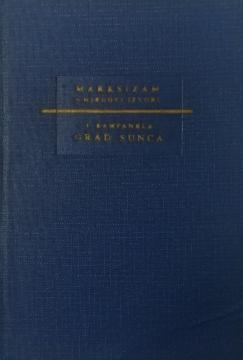
Grad sunca
The City of the Sun (Latin: Civitas Solis, published in 1623) is a visionary, esoteric, almost mystical utopia, deeply imbued with the Renaissance spirit, Egyptian astrology, and the Christian hope for a perfect society.
Campanella, a Dominican, philosopher, poet and rebel, wrote it in prison, after being tortured and sentenced to death for heresy and conspiracy against the Spaniards – the work emerged from his suffering as a dream of a world without tyranny, poverty and ignorance.
The story is structured as a dialogue: a Genoese sailor tells a Knight Hospitaller about his journey to the miraculous City of the Sun, located on a hill near the equator, surrounded by seven concentric walls named after the planets (Mercury, Venus, Mars, Jupiter, Saturn, Moon, Sun). At the top of the hill stands a temple dedicated to the Sun – a symbol of divine wisdom and natural religion. The city is a microcosm: mathematically perfect, cosmically attuned, where everything is subordinated to the harmony of the universe.
In this city there is no private property – land, houses, food, even women and children are shared. Everyone works four hours a day, the rest is dedicated to learning, art, exercise and prayer. Education begins at birth: children learn from the pictures on the walls (the entire city is a living encyclopedia – the walls are painted with science, history, animals, plants). Marriages are arranged according to eugenics and astrology, and love is subordinated to the common good. Power is held by three rulers: Power (army), Wisdom (science) and Love (health, reproduction) – above them is the Priest-Sun, an enlightened ruler who combines reason and faith.
Campanella mixes Plato, Christianity, Pythagorean numerology and Renaissance science: astrology determines the time for sowing, marriages, wars; religion is natural, without dogmas, directed towards God through the Sun and the stars. There is no poverty, no envy, no war – everything is in harmony with nature and the cosmos.
The City of the Sun is not a cold dystopia; it is a warm, almost poetic dream of humanity overcoming selfishness. Campanella believes that such a city is possible – if people turn to reason, nature and God. The work influenced later utopias, but also thinkers like Campanella himself, who dreamed of a universal monarchy under the pope.
One copy is available
- Yellowed pages