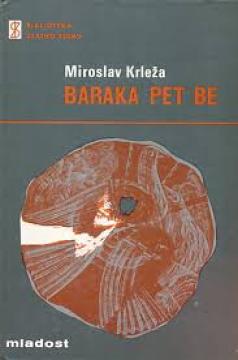
Baraka Pet Be i druge novele
The collection "Baraka Pet Be i druge novele" brings a selection of Krleža's anti-war novels from the period 1916–1920s, focusing on the senselessness of World War I, the suffering of the Home Guard and the downfall of Austria-Hungary.
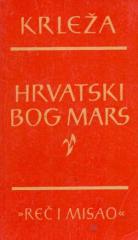
This edition of Mladost (4th edition, with an afterword by Marijan Matković) collects some of Krleža’s most powerful short stories from his youth and early adulthood, mostly from the cycle The Croatian God Mars (1922–1947). The book presents a selection of anti-war prose that exposes the horrors of war, class hypocrisy, national chaos, and the dehumanization of ordinary people (peasants, intellectuals, home guards) thrown into an imperial slaughterhouse.
The title short story “Barrack Five Be” (1921) – the pinnacle of expressionism and naturalism – is set in a military hospital behind the Galician front in 1916/17. In Barrack 5B, immobile wounded soldiers of various nationalities (Croats, Hungarians, Slovaks, Russians, etc.) die, while Count Axelrode flees, returns, shoots prisoners, and organizes a grotesque “victory” parade. The focus is on the student Vidović (shot in the lung), who in agony experiences a vision of the Croatian wooden Christ on a muddy road – a symbol of an abandoned, crippled nation. Death is not heroic, but pathetic, in a torrent of blood and helpless rebellion.
Other short stories (Battle of Bistrica Lesna, Royal Hungarian Home Guard Novel, Three Home Guards, Home Guard Jambrek, Death of Franjo Kadaver, Croatian Rhapsody) complete the picture: from the irony of the “Croatian god Mars”, through the fates of the peasants (Jambrek), to mass scenes of chaos and death. Krleža uses naturalistic details (stink, pus, bloody bandages), expressionistic screams and impressionistic images – all in the service of anti-war, social and national criticism.
The book is a classic reading and a testament to Krleža’s early style: bitter, rhetorical, condensed, without illusions about the “great” war. It remains shockingly relevant.
One copy is available
- A message of a personal nature