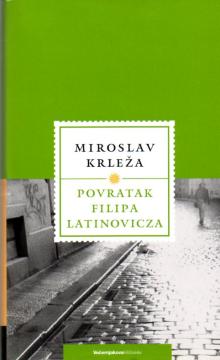
Povratak Filipa Latinovicza

Povratak Filipa Latinovicza

Miroslav Krleža

The Return of Filip Latinovicz is one of Miroslav Krleža's most famous novels. This novel is significant in our literature because it is considered the first fully modern Croatian novel.

The novel does not have a classic composition, or even a fully branched plot, but it is nevertheless complex due to the psychological portrayal and development of the characters, especially the main character, which is the hallmark of a modern novel.

The plot of the novel is set in the twenties of the last century, but the fable is full of digressions, retrospections and thoughts of the characters. The main character, Filip Latinovicz, is a representative of an intellectual misunderstood in a harsh, primitive world. He does not understand such a world, just as this world does not understand him. That is why the emphasis of this novel is on the alienation of the individual from the world, and on his not belonging to the environment in which he is forced to live.

To some extent, this novel is also a novel-essay, because it abounds in long discussions about painting and art in general, since the main character is a painter, and the views expressed are the views of the writer himself. The return of Filip Latinovicz was published in 1932, and to this day it holds a high place on the list of the best Croatian modernist novels.

Editor
Branka Primorac, Seid Serdarević
Illustrations
Stanko Abadžić
Graphics design
Vanja Cuculić
Dimensions
21 x 12.52 cm
Pages
257
Publisher
Večernji list, Zagreb, 2004.
 
Latin alphabet. Hardcover with dust jacket.
Language: Croatian.
ISBN
9-53-985875-5

Multiple copies are available

Copy number 1

Condition:Used, excellent condition

Copy number 2

Condition:Used, excellent condition

Copy number 3

Condition:Unused

Copy number 4

Condition:Used, excellent condition
 

Are you interested in another book? You can search the offer using our search engine or browse books by category.

You may also be interested in these titles

Izabrane pjesme

Izabrane pjesme

Miroslav Krleža
Matica hrvatska, 1963.
Croatian. Latin alphabet. Hardcover with dust jacket.
9.99
Hrvatski bog Mars

Hrvatski bog Mars

Miroslav Krleža
Rad, 1965.
Serbian. Latin alphabet. Paperback.
1.99
Avlija

Avlija

Vasilije Kukić

The courtyard is a deep analysis of human relations in the Bosnian context, where Kukić explores the universal themes of love, freedom and morality through the prism of the community in the courtyard, with a strong sense of the local color and historical

Kosmos, 1963.
Serbian. Latin alphabet. Hardcover with dust jacket.
3.56
Moj Argentinski Tango - ispovest Mornara Pešića

Moj Argentinski Tango - ispovest Mornara Pešića

Predrag Aleksijević

The book is an authentic, poignant, and humorous confession of the Belgrade sailor and bohemian Milorad Mornar Pešić (1934–2018), which Predrag Aleksijević wrote down and shaped into a confessional novel.

NIRO Exportpress, 1984.
Serbian. Latin alphabet. Paperback with dust jacket.
5.26
Pet stoljeća hrvatske književnosti # 31 - Članci, Grobničko polje, Teuta - Članci, pjesme, Šilo za ognjilo, Matija Gubec

Pet stoljeća hrvatske književnosti # 31 - Članci, Grobničko polje, Teuta - Članci, pjesme, Šilo za ognjilo, Matija Gubec

Dimitrija Demeter, Mirko Bogović
Zora, 1968.
Croatian. Latin alphabet. Hardcover with dust jacket.
4.993.74
Sat koji otkucava samo tik

Sat koji otkucava samo tik

Ivan Vidić

The ticking clock is a novel about love, betrayal, revenge and crime. Beginning as a story about the passionate love and marriage of the university professor Julio and the young student Lujza, the novel sovereignly takes surprising genre directions.

Hena Com, 2023.
Croatian. Latin alphabet. Hardcover with dust jacket.
16.24