Crtice iz slavonske povijesti s osobitim obzirom na prošlost županija: Križevačke, Virovitičke, Požeške, Cisdravske baranjske, Vukovske i Srijemske, te Kr. i slob. grada Osijeka u srednjem i novom vijeku
Antique
Rare book

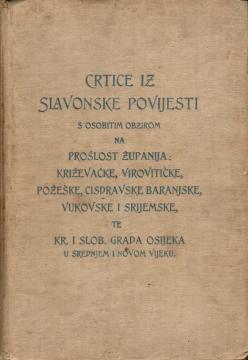
Crtice iz slavonske povijesti s osobitim obzirom na prošlost županija: Križevačke, Virovitičke, Požeške, Cisdravske baranjske, Vukovske i Srijemske, te Kr. i slob. grada Osijeka u srednjem i novom vijeku

Josip Bösendorfer

In his major work from 1910, Josip Bösendorfer provides an overview of Slavonian history with an emphasis on the past of the counties (Križevci, Virovitica, Požega, Baranja, Vukovo, Srijem) and the city of Osijek in the Middle Ages and the modern era.

"Sketches from Slavonian history with special reference to the past of the counties: Križevci, Virovitica, Požega, Cisdravska Baranja, Vukovska and Srijem, and the Christian and Slavic city of Osijek in the Middle Ages and Modern Times" is a classic work of Croatian historiography published in Osijek in 1910 by Josip Bösendorfer (1876–1957), a prominent Slavonian historian, high school professor, director of the Osijek Museum and long-time researcher of the regional past.

The book presents a systematic overview of the history of Slavonia from the Middle Ages to the 19th century, with special reference to the administrative, political, economic and social history of individual Slavonian counties. Bösendorfer is based on archival material (Hungarian-Croatian, Austrian and local sources), critically analyses and corrects earlier works (especially those of the Hungarian historian D. Csánki), and brings numerous new data and documents.

Special attention is paid to:

  • Križevci, Virovitica and Požega counties — their territorial development, noble families and medieval institutions.
  • Baranja, Vukovar and Srijem — areas of eastern Slavonia and Srijem, which were exposed to Turkish conquests, wars and later recolonization.
  • Osijek — development from a medieval settlement through a fortress to a royal and free city in 1809.

The work covers topics such as feudal relations, agrarian conditions, church institutions, the influence of the Ottomans, the Habsburgs, the Military Border and the process of modernization in the 18th and 19th centuries. The style is scholarly and popular — clear, documented, with a wealth of facts, but readable for a wider audience.

"Sketches" have long remained a fundamental work for the study of Slavonian history and have been reprinted several times (e.g. in 1994). Even today, they are considered an indispensable source for anyone interested in the regional history of eastern Croatia. With this work, Bösendorfer laid the foundations of modern Slavonian historiography.

Dimensions
27 x 18 cm
Pages
482
Publisher
Naklada Radoslava Bačića, Osijek, 1910.
 
Latin alphabet. Hardcover.
Language: Croatian.

One copy is available

Condition:Used, good condition (visible signs of use)
 

Are you interested in another book? You can search the offer using our search engine or browse books by category.

You may also be interested in these titles

Obrtna politika

Obrtna politika

Ivan Čupak

A practical and programmatic book on craft policy in Croatia at the end of World War I. Ivan Čupak analyzes the problems, position and prospects of Croatian crafts and proposes measures for their protection and improvement.

Vlastita naklada, 1918.
Croatian. Latin alphabet. Hardcover.
12.34
Komunizam i čovjek: Odnos vlasti i pojedinca u Hrvatskoj (1958.–1972.)

Komunizam i čovjek: Odnos vlasti i pojedinca u Hrvatskoj (1958.–1972.)

Josip Mihaljević

Josip Mihaljević's book analyzes the relationship between the government and the individual in communist Croatia (1958–1972), through repressive mechanisms, ideological pressures, and restrictions on personal freedom in the socialist system.

Hrvatski institut za povijest, 2016.
Croatian. Latin alphabet. Hardcover.
17.26
Dan kada je nastala država Hrvatska 1991.

Dan kada je nastala država Hrvatska 1991.

Davorin Rudolf, Vladimir Šeks, Jasna Omejec

The collection brings together scholarly works on key political, legal, and diplomatic processes that led to the creation of the Croatian state in 1991, analyzing the decisions, actors, and international circumstances crucial to independence.

Hrvatska akademija znanosti i umjetnosti (HAZU), 2015.
Croatian. Latin alphabet. Paperback.
17.26
Gledanje u viđeno – ratovanje u Srbiji 1914. godine

Gledanje u viđeno – ratovanje u Srbiji 1914. godine

Branimir Knežević

Looking into the Past - Warfare in Serbia in 1914 is a valuable documentary-diary prose by Branimir Knežević, which includes records of warfare on the Serbian battlefield, interspersed with reflections.

Fortuna d.o.o., 2014.
Croatian. Latin alphabet. Hardcover.
10.62
Iznevjereni grad: Dubrovnik 1991

Iznevjereni grad: Dubrovnik 1991

Petar Kriste

A memoir by Petar Krista, a member of the Dubrovnik Crisis Staff, about the first months of the siege of the city. The work records the political background, military reality, and personal drama of the defense of Dubrovnik.

Golden marketing, 2000.
Croatian. Latin alphabet. Hardcover.
18.56
Povijest i kultura Hrvata kroz 1000 godina: Od velikih seoba do XVIII. stoljeća

Povijest i kultura Hrvata kroz 1000 godina: Od velikih seoba do XVIII. stoljeća

Horvat
Josip Horvat

One of the most prominent Croatian cultural historians, Josip Horvat, in one of his best texts, not only describes the cultural achievements of Croats, but also analyzes them on the basis of political, social and other events that Croatian history is full

Knjigotisak d. o. o., 2009.
Croatian. Latin alphabet. Hardcover.
12.209.15