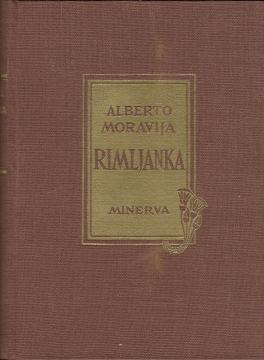
Rimljanka
Adriana, a beautiful Roman girl from a poor background, wants a normal life, but her mother pushes her into posing for painters and prostitution. Her love affairs lead her through betrayal, violence and corruption to her final resignation.
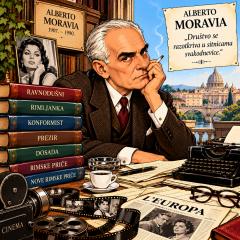
The Roman Woman is one of Alberto Moravia's most famous novels, published in 1947, with the protagonist Adriana narrating in the first person. The story takes place in Rome in the 1930s, during Mussolini's fascist regime, but politics are mostly in the background – serving as a corrupt, violent context that shapes the characters' destinies.
Adriana, a young, beautiful girl from the people, lives with her mother Margherita, a poor seamstress who is bitter about her own past (she was abandoned while pregnant). Her mother sees Adriana's beauty as capital: she forces her to pose naked for painters for money, hoping that this will lead to a better life. Adriana dreams of a simple, honest marriage and family, but she falls in love with Gino, a charming but deceitful driver. He exploits and cheats on her, and the marriage falls apart.
After that, Adriana falls into the world of prostitution. Her mother introduces her to Gisella, who introduces her to paid relationships. Here appears Astarita, a powerful fascist police official – obsessed with Adriana, who uses his power to force her to have sex and become his lover. Adriana hates him, but agrees out of money and fear.
The key man becomes Mino (Giacomo), a student anti-fascist and idealist who distributes leaflets against the regime. Adriana falls sincerely in love with him – he represents something pure and honest to her. But Mino is arrested; under torture he betrays his comrades, becomes indifferent and broken. Adriana, pregnant by the bully Sonzogno (a criminal and murderer), tries to save Mino, but he refuses her help and love.
The novel ends with Adriana's complete resignation: she gives birth to a child, lives with her mother in poverty, accepts her fate without illusions. Through her, Moravia depicts the fate of women in a patriarchal, corrupt society – where beauty becomes a curse and honesty impossible. The themes are existential alienation, the impossibility of authentic love, erotic obsession, moral breakdown under totalitarianism, and passivity in the face of fate.
The style is realistic, detailed, with a focus on psychology and physicality. Adriana is a strong, passive heroine – she does not rebel, but swims through life, which allowed Moravia to criticize society through individual destiny. The novel caused a scandal in conservative circles (the church put it on the Index in 1952 for "obscenity"), but also praised – it received the Premio Strega the same year. It influenced neorealism and film – the famous adaptation with Gina Lollobrigida in 1954.
One copy is available