Božja zemlja Nippon: Poučno o Japanu
Rare book
Antique

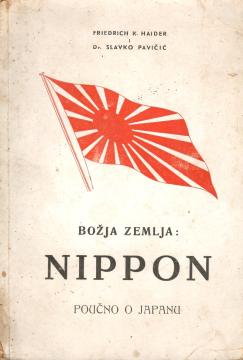
Božja zemlja Nippon: Poučno o Japanu

Friedrich K. Haider, Slavko Pavičić

"God's Land Nippon" by Friedrich K. Haider and Slavko Pavičić is an educational book about Japan, its culture, history, customs and spirituality during World War II. Popular propaganda reading for the NDH.

The booklet is a popular and educational publication intended for a wider audience in the Independent State of Croatia. Slavko Pavičić (1885–1947), a Vinkovci publicist, military historian and editor of the Croatian Encyclopedia, is known for his works on military history. Friedrich K. Haider is probably the author of most of the content on Japan, while Pavičić participated in the preparation or addition of the text.

The book provides an overview of Japan as an exotic, highly disciplined and spiritually rich country – “God’s Land”. It describes Japanese history, Shintoism and Buddhism, the imperial cult, samurai tradition, customs, family life, art and warrior spirit. It particularly emphasizes Japanese loyalty to the emperor, national discipline, industry and willingness to sacrifice – topics that had a clear propaganda weight in the war year of 1942, because Japan was an ally of the Axis powers.

The style is simple, popular and accessible, with the aim of bringing the distant Asian power closer to the Croatian reader in a positive, almost idealized light. The book is part of a series of publications from the time of the Independent State of Croatia that represented the allied countries (Germany, Italy, Japan) in order to shape public opinion and strengthen awareness of the new world order.

The edition is a rare antiquarian copy and testimony to the publishing industry in wartime Zagreb. It reflects the political context of the time and the interest in Japan as the "miracle of Asia" – a modern industrial power that retained deep traditional roots.

God's Land Nippon is valuable as a historical document and as an example of how distant cultures were written about in Croatia in the 1940s – with a mixture of informativeness, admiration and ideological coloring. An interesting read for fans of old travel and popular-scientific literature, as well as those who study Croatian non-fiction of the Second World War.

Dimensions
20 x 13.5 cm
Pages
63
Publisher
Nakladna knjižara Velebit, Zagreb, 1942.
 
Latin alphabet. Paperback.
Language: Croatian.

One copy is available

Condition:Used, very good condition
Damages or inconvenience notice:
  • Slight damage to the cover
 

Are you interested in another book? You can search the offer using our search engine or browse books by category.

You may also be interested in these titles

Zaraćeno poraće: Konfliktni i konkurentski narativi o stradanju i iseljavanju Talijana Istre

Zaraćeno poraće: Konfliktni i konkurentski narativi o stradanju i iseljavanju Talijana Istre

Franko Dota

The book analyzes how conflicting historical narratives about the suffering and mass emigration of Italians from Istria and Rijeka developed in Croatia and Italy after World War II (1943–1956), debunking myths and encouraging an empathetic approach to the

Srednja Europa, 2010.
Croatian. Latin alphabet. Paperback.
11.32
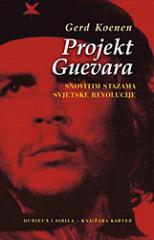
Projekt Guevara: Snovitim stazama svjetske revolucije

Projekt Guevara: Snovitim stazama svjetske revolucije

Gerd Koenen

This book is a biography of the historical figure and icon of the twentieth century, Ernesto Che Guevara - in light of his project of a world revolution, which Koenen, after Bruce Chatwin, will call dream paths.

Durieux, 2011.
Croatian. Latin alphabet. Hardcover with dust jacket.
17.62
Žene Italije

Žene Italije

Maria Castellani

An overview of the history and position of Italian women from antiquity to Mussolini's fascist Italy, with an emphasis on their contribution to society and culture. A popular educational publication from the period of the Independent State of Croatia, wit

Società Editrice di Novissima, 1941.
Croatian. Latin alphabet. Paperback.
13.24
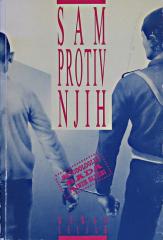
Sam protiv njih

Sam protiv njih

Roman Leljak

A non-fiction work by a Slovenian investigator of the UDB archives. The author, a former KOS employee, left the army after learning about the crimes of the Yugoslav army during the war and the post-war period, and dedicated himself to exposing the secret

Vlastita naklada, 1990.
Croatian. Latin alphabet. Paperback.
16.42
Kominterna

Kominterna

Comintern (1934) depicts the emergence, organization, and activities of the Communist International and warns of its revolutionary goals and international influence from the perspective of Catholic social thought.

Moderna socijalna knjižnica (MOSK), 1934.
Croatian. Latin alphabet. Paperback.
26.38
Ljudi-miševi

Ljudi-miševi

Manuel Leguineche, Jesus Torbado

The book "Mice People" by Manuel Leguineche and Jesús Torbad is an extremely powerful testimony about human destinies during and after the Spanish Civil War (1936-1939).

Alfa, 1979.
Croatian. Latin alphabet. Hardcover with dust jacket.
6.32