Na rubu: dnevnik iz jedne tragedije
Rare book
Antique

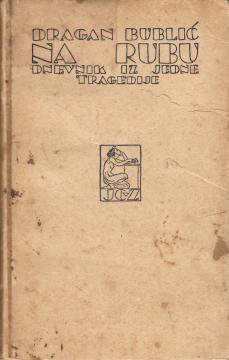
Na rubu: dnevnik iz jedne tragedije

Dragan Bublić

In his book On the Edge: A Diary from a Tragedy (1920), Dragan Bublić presents anti-war diary entries – an intimate account of personal and collective tragedy in World War I and the aftermath.

Dragan Bublić (Garešnica, 1895 – Klagenfurt, 1987), a Croatian writer and publicist, published the book On the Edge: A Diary from a Tragedy in 1920. It is his first significant prose work, of an autobiographical-diary character, which belongs to post-war literature and early expressionism in Croatian literature.

The work was created on the basis of Bublić's personal experience: participation in World War I, the withdrawal of the Serbian army through Albania, emigration, stay in France and Tunisia, and disillusionment with war and post-war reality. The book depicts a man on the edge of existence – physically, mentally, and morally broken in the midst of war chaos, hunger, disease, death, and the senselessness of a great conflict. Bublić introspectively and expressively records the inner state of an individual faced with collective tragedy, war horrors, and post-war disillusionment.

The critics of that time (Ljubomir Micić in Zenit, Milan Ćurčin in Nova Evropi, Vladimir Jurković and others) recognized the book as a powerful anti-war record and one of the first books in the Croatian language that deals with war trauma in a modern, subjective way. The style is fragmentary, diary-like, with expressionist elements – emphasized emotionality, visions, inner monologue and a sense of absurdity.

On the Edge stands out as one of Dragan Bublić's rare more successful artistic achievements. Later works (e.g. Assassination, On the Willow) transition into non-fiction and novels with a clear political tendency. This book remains an important document of the post-war generation, a testimony to the war trauma and disillusionment of Yugoslav idealism after 1918.

Today, the work is an antiquarian rarity, sought after among collectors of 20th-century Croatian literature. It represents an early example of modern war prose in Croatian literature, alongside works such as Krleža's war records, but in a more intimate, diary form.

Editor
Ivo Kršić
Dimensions
19.5 x 12 cm
Pages
95
Publisher
Nakladni zavod Josip Čaklović, Zagreb, 1920.
 
Latin alphabet. Hardcover.
Language: Croatian.

One copy is available

Condition:Used, good condition (visible signs of use)
Damages or inconvenience notice:
  • Stains on cover
  • Library stamp
 

Are you interested in another book? You can search the offer using our search engine or browse books by category.

You may also be interested in these titles

Kako smo ubili Jozu Leutara: Potresna ispovijest o jednom montiranom procesu

Kako smo ubili Jozu Leutara: Potresna ispovijest o jednom montiranom procesu

Dominik Ilijašević-Como

The autobiographical confession of Dominik Ilijašević Coma, the second defendant in the Leutar case. It reveals the background of the trial against six Croats for the assassination of federal deputy minister Jozo Leutar in 1999.

Vlastita naklada, 2005.
Croatian. Latin alphabet. Hardcover with dust jacket.
14.36
Liječnikovi zapisci

Liječnikovi zapisci

Filip Marušić-Davidović

Doctor's Notes by F. D. Marušić (1906) is a collection of realistic sketches from medical practice in a Dalmatian village. It depicts the difficult life of poor people, diseases, misery and social injustices through the eyes of a doctor.

Matica hrvatska, 1006.
Croatian. Latin alphabet. Hardcover.
12.46
Pero i Pava

Pero i Pava

Paula Preradović

A historical novel about the great love of Croatian poet Petar Preradović and his first wife Pavica (Pava) from a Dalmatian noble family. A touching story of love, marriage, war and tragic fate in the turbulent 19th century.

Nakladni zavod Ante Velzek, 1940.
Croatian. Latin alphabet. Hardcover with dust jacket.
3.26 - 11.42
Banco: Sve ili ništa

Banco: Sve ili ništa

Henri Charrière

In his book Banco – All or Nothing, Henri Charrière describes his life after escaping from prison in French Guiana. Seeking redemption, he embarks on an honest life, but through numerous adventures and shady dealings, he once again tests the limits of fre

Alfa, 1977.
Croatian. Latin alphabet. Hardcover with dust jacket.
11.56
Mein Kampf / Moja borba

Mein Kampf / Moja borba

Adolf Hitler

Hitler's book combines autobiography and political manifesto, laying the foundations of Nazi ideology. The work has been banned in many countries for promoting hatred, but it remains a historical document that reveals the origins of Nazi crimes.

Kvrga izdavaštvo, 1999.
Croatian. Latin alphabet. Hardcover.
27.00
Provincijalac

Provincijalac

Momo Kapor

As much as Foliranti is a story about Kapor's student days in Belgrade in the late fifties, Provincial is a book that evokes memories of his childhood in Sarajevo, where the author spent the first years of his life.

Znanje, 1984.
Serbian. Latin alphabet. Paperback.
5.32