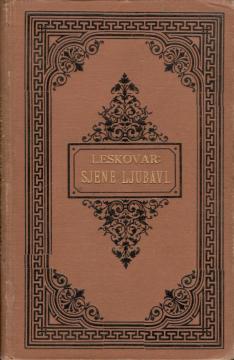
Sjene ljubavi
Antique
Rare book

Sjene ljubavi

Janko Leskovar

A key novel of Croatian modernity. Leskovar depicts the overly sensitive writer Marcel Bušinski, who sinks in passive decadence into the shadows of unrealized, painful love, introspection, and mental weakness. First edition.

Shadows of Love (1898) by Janko Leskovar marks the transition from realism to psychological prose with modernist and decadent features. The external plot is minimal, and the center is a deep analysis of the protagonist's inner world.

The main character Marcel Bušinski is a typical "Leskovarac" - an oversensitive, passive intellectual who lives in the shadow of past emotions and unfulfilled longings (especially for Ljerka). Instead of action, he indulges in introspection, melancholy, despondency and a feeling of powerlessness of will. Love is depicted here as a destructive "shadow" - unattainable, painful and doomed to failure, which leads the hero into emotional isolation and decadence.

Leskovar was inspired by Turgenev's psychological depth and Schopenhauer's pessimism. The style is impressionistic: rich in sensory impressions, subtle mood swings and an atmosphere of melancholy. The novel is compact, focused on the inner monologues and subtle conflicts of the modern individual at the turn of the century.

As one of the purest achievements of early Croatian modernism, Shadows of Love represents a key testimony to the crisis of the contemporary intellectual and a portrait of the "Leskovar" type of character.

Dimensions
19.5 x 12.5 cm
Pages
124
Publisher
Štamparija Karla Albrechta (Jos. Wittasek), Zagreb, 1898.
 
Latin alphabet. Hardcover.
Language: Croatian.

One copy is available

Condition:Used, excellent condition
 

Are you interested in another book? You can search the offer using our search engine or browse books by category.

You may also be interested in these titles

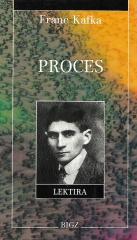
Proces

Proces

Franz Kafka

Kafka wrote The Process between 1914 and 1915, published posthumously in 1925. The novel is unfinished but with an added final chapter by Max Brod. Edition with a foreword by B. Živojinović and an afterword by Walter Killi.

BIGZ, 1990.
Serbian. Latin alphabet. Paperback.
4.26
Andrićeva lestvica užasa

Andrićeva lestvica užasa

Svetislav Basara

A Serbian writer known for his satirical novels, Andrić's Ladder of Horrors dissects the Balkan mentality through a parable of Yugo-nostalgia and national myths. The title alludes to Ivo Andrić as a litmus test for criticism – Balkans claim him or reject

24 sata, 2021.
Serbian. Latin alphabet. Paperback.
11.56
Deobe 1-3

Deobe 1-3

Dobrica Ćosić

This work, awarded the NIN Prize for that year, is considered one of the most significant in Serbian literature after World War II.

Prosveta, 1961.
Serbian. Cyrillic alphabet. Hardcover with dust jacket.
The book consists of 3 volumes
11.42
Deobe

Deobe

Dobrica Ćosić

Deobe is a novel about the tragic division of Serbs into Chetniks and Partisans during World War II. Winner of the NIN Award, it is part of a wider epic trilogy, inspired by Ćosić's experiences and historical documents.

Prosveta, 1963.
Croatian. Latin alphabet. Hardcover with dust jacket.
13.74
Krčma

Krčma

Julian Stryjkowski

The book "Inn" by Julian Stryjkowski, published in 1977, explores life in a small Jewish village in Galicia during the 19th century.

BIGZ, 1977.
Serbian. Latin alphabet. Paperback.
4.38
Usta puna zemlje

Usta puna zemlje

Branimir Šćepanović

The novel "Usta puna zemlje" (1970), the masterpiece of the Serbian writer Branimir Šćepanović, is a psychologically in-depth explorer of the limits of the human soul, solitude and existential freedom, reminiscent of Kafka and Camus.

BIGZ, 1987.
Serbian. Latin alphabet. Paperback.
3.98