O ljubavi
Antique
Rare book

O ljubavi

Ralph Waldo Emerson

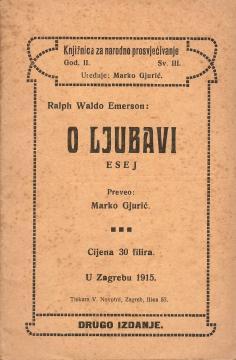
The booklet "On Love" by Ralph Waldo Emerson is a Croatian edition of the famous essay from the collection Essays: First Series (1841), one of the foundational texts of American transcendentalism.

Emerson (1803–1882), an American philosopher, essayist, and poet, in this essay considers love on a higher plane—not simply as a romantic or erotic passion, but as a deep spiritual force that transforms the individual and society. The essay begins with youthful, passionate love that “transforms the world”: the lover sees everything in a new light, nature comes alive, and the senses and imagination are heightened. Love opens the door to heroic and sacred dimensions of life, and establishes marriage and society.

Emerson then moves on to a higher, universal love—one that transcends gender, person, and particularity, and strives for virtue and wisdom everywhere. Love is not just a private matter; it extends toward humanity and the divine. He criticizes superficial, possessive love and advocates freedom of the spirit within relationships. The style is typically Emersonian: poetic, aphoristic, full of natural imagery and transcendental insights.

Marko Gjurić's translation is part of the early 20th century, when Croatia intensively translated world classical and modern literature, especially American transcendentalists and romantics. This edition testifies to the interest of the Croatian intellectual public in Emerson's philosophy of self-reliance, individualism and spirituality in the period before World War I.

The booklet is thin, intended for a wider audience – intellectuals, students and philosophy lovers. Today it is a rare antiquarian publication, interesting for studying the history of translation and reception of American literature in Croatia.

Original title
Love
Translation
Marko Gjurić
Dimensions
15 x 10 cm
Pages
28
Publisher
Vlastita naklada, Zagreb, 1915.
 
Latin alphabet. Paperback.
Language: Croatian.

One copy is available

Condition:Used, excellent condition
 

Are you interested in another book? You can search the offer using our search engine or browse books by category.

You may also be interested in these titles

Head in the Stars – Essays on Science Fiction

Head in the Stars – Essays on Science Fiction

Stephen Zepke

A collection of essays on science fiction that explores its philosophical, cultural, and artistic dimensions and its influence on contemporary thought and popular culture.

Multimedijalni institut, 2020.
English. Latin alphabet. Paperback.
12.42
Izabrani filozofski spisi

Izabrani filozofski spisi

Gottfried Wilhelm Leibniz

The first comprehensive selection of Leibniz's philosophical works in the Croatian language. The selection does not include Theodicy and New Essays, as well as Leibniz's later scientific works.

Naprijed, 1980.
Croatian. Latin alphabet. Hardcover with dust jacket.
18.32
Poslanje žene: Putovi i zadaci feminizma

Poslanje žene: Putovi i zadaci feminizma

Paul Tournier

Paul Tournier's book The Mission of Woman presents the Swiss physician, theologian, and pioneer of "personal medicine"'s reflections on the role and mission of women in the contemporary world, from a Christian and psychological perspective.

Provincijalat franjevaca trećoredaca, 1991.
Croatian. Latin alphabet. Paperback.
5.74
O samoći i drugi ogledi

O samoći i drugi ogledi

Michel de Montaigne

Montaigne is considered the father of the essay (The Views were first published in 1580), a literary form that combines a scientific approach and the author's personal view of the subject.

Hoplit, 2023.
Serbian. Latin alphabet. Paperback.
8.97
Mistika

Mistika

Louis Gardet

The book deals with an in-depth analysis of mystical experiences in different religious traditions, with an emphasis on Christianity and Islam. Gardet, a French theologian and orientalist, explores mysticism as a universal phenomenon that transcends cultu

Kršćanska sadašnjost, 1983.
Croatian. Latin alphabet. Paperback.
7.32
Znamenovanje ruske revolucije

Znamenovanje ruske revolucije

Lav N. Tolstoj

Tolstoy interprets the 1905 revolution as a moral upheaval: violence does not bring justice, but a new yoke. He sees lasting liberation in personal conscience, non-violence and Christian love, not in the state and coercion.

St. Kugli, 1907.
Croatian. Latin alphabet. Hardcover.
17.24