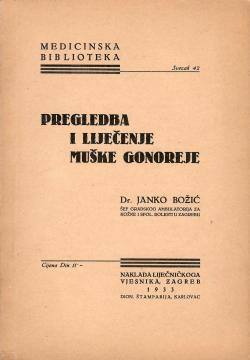
Pregledba i liječenje muške gonoreje
A professional medical manual published in 1933 by Dr. Janko Božić (1889–1975), a prominent Croatian dermatovenerologist and pioneer of the dispensary service for sexually transmitted diseases in Croatia.
The work is a practical and systematic guide for general practitioners and specialists on the then-current standards of diagnosis and treatment of gonorrhea (gonorrhea) in men. In the time before the discovery of penicillin (which only came into widespread use after 1943–1945), gonorrhea was treated predominantly with local and chemical means: protargol, silver preparations, irrigations, urethral dilations, vaccines and various chemotherapeutic agents.
Božić, who founded the first City Outpatient Clinic for Venereal Diseases in Zagreb in 1921, summarized his rich clinical experience in the book. The manual includes:
- anatomy and pathophysiology of male urogenital gonococcal infection,
- clinical forms (acute and chronic urethritis, complications such as epididymitis, prostatitis, strictures),
- examination methods (urethroscopy, palpation, provocation methods),
- laboratory diagnostics (microscopy, Gram staining, culture), differential diagnosis,
- modern therapeutic approaches of that time and prevention and social-medical measures.
The book is written in a clear, practical style, intended primarily for doctors who encounter venereal diseases in outpatient practice. It reflects the level of medical knowledge in interwar Yugoslavia and the efforts to suppress sexually transmitted diseases at a time when they were a major public health problem.
dr. Janko Božić published a similar handbook on syphilis two years earlier (1927), and this one on gonorrhea completes his contribution to venereology. The work is today a bibliographic rarity and an important source for the history of medicine in Croatia, especially for understanding the development of urology, dermatovenerology, and public health before the antibiotic era.
One copy is available