Naš čakavski problem: marginalije
Rare book
Antique

Naš čakavski problem: marginalije

Nikola Štefanić

A collection of short essays, reflections, and marginalia dedicated to the position of the Chakavian dialect in Croatian literature and culture. The work contains a foreword by the writer and critic Antun Bonifačić.

In the book, Štefanić discusses the status of Čakavian in relation to the Štokavian standard, its literary value, the possibilities of its use in contemporary literature, and the cultural and linguistic marginalization of the Čakavian-speaking area (Istria, Kvarner, Dalmatia). The work belongs to the contemporary discussions about the Croatian literary language and dialects, which were alive in the interwar period. The author advocates for greater recognition and literary revival of Čakavian, criticizing the dominance of Štokavian expression.

The book is written in the polemical, personal, and engaged style of a typical marginalist – not as a systematic scientific study, but as a series of subjective observations, criticisms, and suggestions. Bonifačić's preface gives it additional weight in literary circles.

At a time when the Croatian language standard was firmly Štokavian, such works represented voices in defense of dialectal diversity and regional literary traditions. Štefanić's booklet is one of the rarer contributions to the Chakavian linguistic and literary issues of the 1930s.

Today, this edition is a bibliographic rarity, and is occasionally mentioned in Croatian studies curricula as supplementary literature for topics on Croatian dialects, regional literature, and language policy. It represents an interesting document of the interwar debates on Croatian linguistic identity and the relationship between standards and dialects.

Dimensions
20 x 14 cm
Pages
48
Publisher
Vlastita naklada, Zagreb, 1935.
 
Latin alphabet. Paperback.
Language: Croatian.

One copy is available

Condition:Unused
 

Are you interested in another book? You can search the offer using our search engine or browse books by category.

You may also be interested in these titles

Pisma iz progonstva / Zimske beleške o letnjim utiscima / Krotka

Pisma iz progonstva / Zimske beleške o letnjim utiscima / Krotka

Fjodor Mihajlovič Dostojevski

Fyodor Dostoevsky, one of the greatest writers and visionaries in history, is presented in this edition with a selection from his correspondence (Letters from Exile), an account of his first trip to Europe (Winter Notes on Summer Impressions), and the fam

LOM, 2012.
Serbian. Cyrillic alphabet. Paperback.
6.74
Danilo Kiš. Žamor povijesti

Danilo Kiš. Žamor povijesti

Mark Thompson

Danilo Kiš. The Murmur of History by Mark Thompson explores the life and work of Danilo Kiš through six exceptional essays, combining literature and history.

Fraktura, 2021.
Croatian. Latin alphabet. Hardcover with dust jacket.
12.36
Vrtoglavica

Vrtoglavica

Winfried G. M. Sebald

Sebald is not just a storyteller. His narrative process offers a model of consciousness that tells us: to be fully aware of oneself is to suffer from incurable vertigo.

Plato, 2020.
Serbian. Latin alphabet. Paperback.
6.52
Po-etika, knjiga druga

Po-etika, knjiga druga

Danilo Kiš

A collection of interviews that complements the first book of essays from 1972. As a lecturer in Serbo-Croatian at the University of Bordeaux, Kiš reveals in conversations the core of his "po-ethics" - a morally and aesthetically charged vision of literat

Ideje, 1974.
Serbian. Latin alphabet. Paperback.
8.56
Pismo nerođenom djetetu

Pismo nerođenom djetetu

Oriana Fallaci

One of the most moving and courageous works of world literature of the 20th century. Written as a long monologue by a pregnant woman (Fallaci herself), the book is at once an intimate confession, a feminist manifesto, and a philosophical confrontation wit

Znanje, 2009.
Croatian. Latin alphabet. Paperback.
4.56
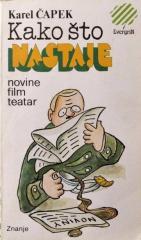
Kako što nastaje: novine, film, teatar

Kako što nastaje: novine, film, teatar

Karel Čapek

In a witty and instructive essay, Čapek describes how a newspaper, a film, and a theater play are created. Through humor and irony, he shows the complexity of the process – from idea to realization – and the different perspectives of the participants, dem

Znanje, 1985.
Croatian. Latin alphabet. Paperback.
4.76