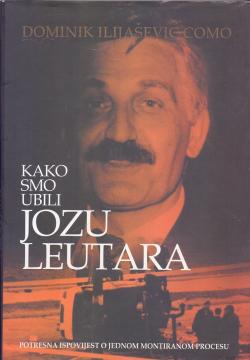
Kako smo ubili Jozu Leutara: Potresna ispovijest o jednom montiranom procesu
The autobiographical confession of Dominik Ilijašević Coma, the second defendant in the Leutar case. It reveals the background of the trial against six Croats for the assassination of federal deputy minister Jozo Leutar in 1999.
The book presents the controversial autobiographical confession of Dominik Ilijašević Come, commander of the HVO special unit “Maturice” from Kiseljak. Ilijašević was the second defendant in the famous Leutar case – the trial of six Croats accused of organizing the assassination of the Deputy Minister of the Interior of the Federation of Bosnia and Herzegovina Joza Leutar.
Leutar was seriously wounded on March 16, 1999 in Sarajevo by an explosive device placed under an official car, and died on March 28. The assassination caused great political tensions between Croats and Bosniaks in the Federation. Ilijašević and the other defendants (Ivan Andabak, Jedinko Bajkuša, Mario Milićević, Željko Ćosić and Zoran Bašić) spent months in detention. After a marathon trial, the Cantonal Court in Sarajevo acquitted them of all charges due to lack of evidence, and the verdict was confirmed at higher instances.
In the book, Ilijašević describes in detail how, in his opinion, the entire process was politically rigged in order to discredit the Croatian leadership and influence relations in BiH. He accuses high-ranking officials of the Federation Ministry of Interior (Mehmed Žilić, Faik Lušić), prosecutors, judges, protected witness Merim Galijatović (a multiple offender), and representatives of the international community, especially Jacques Paul Klein. He claims that the goal was to preserve the legitimacy of the international administration in BiH, and not to find the real killers.
Ilijašević writes openly about the pressure, defense costs (around 250,000 euros), betrayals, and the lack of support from some Croatian politicians and institutions. The book provides his personal perspective – from the arrest by the “black hoods,” through his days in prison, to the fight to prove his innocence. He does not offer a definitive answer as to who killed Leutar, but he strongly criticizes the judicial and political system that, in his opinion, sacrificed the innocent six in order to cover up the real perpetrators.
The work caused great controversy: some saw it as a courageous confession and exposure of a rigged trial, others as an attempt at justification and revisionism. Ilijašević was later convicted of war crimes in central Bosnia (Stupni Do and the surrounding area), served part of his sentence, and was briefly on the run.
One copy is available