
Stepski vuk

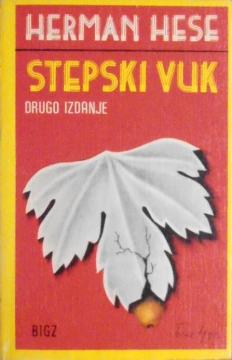
Stepski vuk

Hermann Hesse

The novel follows Harry Haller, a lonely intellectual torn between the human pursuit of spirituality and the wild, animal nature of the "steppe wolf". Through an identity crisis, he searches for meaning in the modern world.

Steppenwolf (1927) is one of the most famous works by the German-Swiss writer Hermann Hesse, written during a period of profound personal and existential crisis. Through the device of a discovered manuscript, the novel presents the confession of Harry Haller, a forty-year-old intellectual who views himself as a being split into two irreconcilable halves: the lofty human spirit and the raw, solitary "Steppenwolf." Haller despises the superficiality of bourgeois society, as well as the pettiness and militarism of his era, yet he fails to find inner peace or a sense of belonging. A turning point occurs during a night out when he meets Hermine, a mysterious woman who introduces him to an entirely new world of physical pleasures, dance, jazz, and intoxicants. Hermine shatters his illusion of a simple duality, teaching him that the human soul is composed not merely of two parts, but of an infinite multitude of layers. Through her, he also meets Pablo, a saxophonist, and a young woman named Maria; together, they help him break free from his rigid intellectual stiffness. The novel reaches its climax in the "Magic Theater"—a surreal realm of the subconscious and fantasy where, through a series of symbolic images, Harry learns to embrace every aspect of his personality. Using the motifs of humor and laughter, Hesse offers the only true remedy for despair: the individual's ability not to take themselves too seriously and to discover a higher spiritual harmony amidst the absurdity of everyday life.

Original title
Steppenwolf
Translation
Sonja Perović
Editor
Vladimir Stojšin
Graphics design
Bole Miloradović
Dimensions
18 x 11.5 cm
Pages
273
Publisher
BIGZ, Beograd, 1980.
 
Distribution: 30,000 copies
 
Latin alphabet. Paperback.
Language: Serbian.

One copy is available

Condition:Used, excellent condition
 

Are you interested in another book? You can search the offer using our search engine or browse books by category.

You may also be interested in these titles

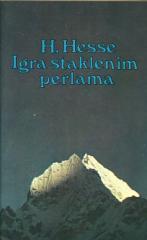
Igra staklenim perlama

Igra staklenim perlama

Hermann Hesse

A philosophical novel set in a fictional future, in the province of Kastalia, where the intellectual elite cultivate a spiritual discipline known as the Glass Bead Game. The novel follows the life of Joseph Knecht, who goes from student to Magister Ludi,

Sveučilišna naklada Liber (SNL), 1979.
Croatian. Latin alphabet. Hardcover with dust jacket.
9.30
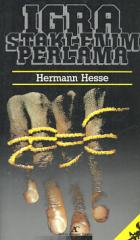
Igra staklenim perlama

Igra staklenim perlama

Hermann Hesse

The novel "The Glass Bead Game", published in 1943, is Hermann Hesse's greatest, almost life-long work, which he wrote for almost 12 years.

August Cesarec, 1987.
Croatian. Latin alphabet. Paperback.
8.32
Narziß und Goldmund

Narziß und Goldmund

Hermann Hesse

In the novel Narcissus and Chrysostom, Hermann Hesse follows two friends: the ascetic monk Narcissus and the artistically restless Chrysostom, who search for the meaning of life through wanderings, love, and suffering.

Suhrkamp Verlag, 1971.
German. Latin alphabet. Hardcover with dust jacket.
7.42
Deobe 1-3

Deobe 1-3

Dobrica Ćosić

This work, awarded the NIN Prize for that year, is considered one of the most significant in Serbian literature after World War II.

Prosveta, 1961.
Serbian. Cyrillic alphabet. Hardcover with dust jacket.
The book consists of 3 volumes
11.42
Zagrepčanka

Zagrepčanka

Branislav Glumac

Branislav Glumac published a novel without periods or commas in 1974, as the relentless stream of thought of a young rebel. Published in socialist Yugoslavia, the work caused a scandal with its openness and became a classic about generational rebellion.

IROS, 1986.
Croatian. Latin alphabet. Hardcover.
8.24
Jedna Svanova ljubav

Jedna Svanova ljubav

Marcel Proust
Rad, 1984.
Serbian. Latin alphabet. Paperback.
2.98