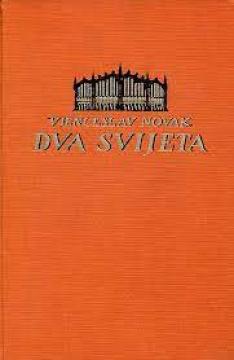
Dva svijeta
Antique

Dva svijeta

Vjenceslav Novak

A psychological novel about musician Amadej Zlatanić who, after studying in Prague, returns to Croatia, where he faces the misunderstanding of his petty-bourgeois surroundings and ends up in a madhouse. The conflict between artistic ideals and reality.

The main character is Amadej Zlatanić, a talented musician and composer. After successfully studying at the conservatory in Prague, full of artistic ideals and European musical influences, he returns to his native Croatia. Instead of the expected understanding and opportunities for creativity, he encounters a provincial petty-bourgeois environment*, social conventions, material concerns and a complete lack of understanding of his surroundings.

The novel masterfully depicts the clash of two worlds: the inner, ideal world of art, music and creative freedom versus the outer, crude, utilitarian and culturally backward world of Austro-Hungarian Croatia at the beginning of the 20th century. Novak, who was himself a music pedagogue, uses music as a key motif and metalanguage – descriptions of compositions, organ improvisations and Amadej's inner experiences of music pass into poetic and symbolic layers, showing the hero's creative process and spiritual disintegration.

Gradually, Amadeus's artistic integrity collapses under the pressure of social norms, financial problems, loneliness, and lack of cultural stimulation. The novel culminates in his mental breakdown and ending up in a madhouse – a classic motif of the downfall of a sensitive intellectual in a hostile environment.

The work emphasizes the themes of the loneliness of the artist, cultural backwardness, the conflict between the individual and society, and the duality of the apparent and the imagined. Novak successfully combines realistic social analysis with deep psychological introspection, using the musician's own experience for rich musical descriptions.

Translation
A. Martinović
Editor
Slavko Ježić
Dimensions
22.5 x 15 cm
Pages
206
Publisher
Minerva nakladna knjižara, Zagreb, 1932.
 
Latin alphabet. Hardcover.
Language: Croatian.

Two copies are available

Copy number 1

Condition:Used, very good condition

Copy number 2

Condition:Used, good condition (visible signs of use)
Damages or inconvenience notice:
  • Stains on cover
  • Traces of patina
 

Are you interested in another book? You can search the offer using our search engine or browse books by category.

You may also be interested in these titles

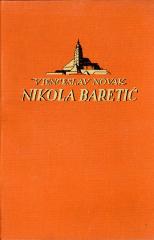
Nikola Baretić

Nikola Baretić

Vjenceslav Novak

Nikola Baretić follows the fate of the main character in the Senj area, faced with jealousy, marital conflicts and social pressures. A realistic novel about passions, honor and decay in a 19th century petty-bourgeois environment.

Minerva nakladna knjižara, 1932.
Croatian. Latin alphabet. Hardcover.
4.993.74 - 5.76
Izabrane pripovijesti

Izabrane pripovijesti

Vjenceslav Novak
Matica hrvatska, 1925.
Croatian. Latin alphabet. Hardcover.
The book consists of 4 volumes
16.99
Tri mušketira 1-2

Tri mušketira 1-2

Alexandre Dumas

Dumas' version of the story depicts the adventures of d'Artagnan and his friends from 1625 to 1628.

Epoha, 1966.
Croatian. Latin alphabet. Hardcover with dust jacket.
The book consists of two volumes
9.48
Pustolovine Toma Sawyera

Pustolovine Toma Sawyera

Mark Twain

The Adventures of Tom Sawyer is the first truly realistic children's novel, not only in American but also in world children's literature. Twain's most famous work and a favorite children's book in which the writer described his boyhood experiences.

Nakladni zavod Hrvatske, 1947.
Croatian. Latin alphabet. Hardcover.
16.32
Usta puna zemlje

Usta puna zemlje

Branimir Šćepanović

The novel "Usta puna zemlje" (1970), the masterpiece of the Serbian writer Branimir Šćepanović, is a psychologically in-depth explorer of the limits of the human soul, solitude and existential freedom, reminiscent of Kafka and Camus.

BIGZ, 1987.
Serbian. Latin alphabet. Paperback.
3.98
Zagrepčanka

Zagrepčanka

Branislav Glumac

Branislav Glumac published a novel without periods or commas in 1974, as the relentless stream of thought of a young rebel. Published in socialist Yugoslavia, the work caused a scandal with its openness and became a classic about generational rebellion.

IROS, 1986.
Croatian. Latin alphabet. Hardcover.
8.24