Zbogom, dragana moja

Zbogom, dragana moja

Raymond Chandler

Raymond Chandler's classic gritty crime novel, Goodbye, My Darling (1940), the second novel featuring private detective Philip Marlowe, takes us through the dark streets of Los Angeles and fictional Bay City in the 1930s.

Marlowe, a cynic and moralist, receives a routine missing person case, but becomes entangled in a web of corruption, betrayal and violence. Big, impulsive Moose Malloy, fresh out of prison, seeks out his lost love Velma Valento at the old Florian's nightclub, now reserved for blacks. In the chaos, Malloy kills the new owner and disappears, leaving Marlowe to investigate under the watchful eye of an indifferent Lt. Nulty.

With the help of whiskey, Marlowe tempts the widow Jessie Florian, who reveals to him that Velma is dead and hands over her photograph. A new client quickly appears, the arrogant Lindsay Marriott, who sends him down a dark avenue with a ransom for a stolen pearl necklace. Marlowe is beaten and Marriott is dead – a victim of murder. He is rescued by Anne Riordan, the daughter of a parole officer, who discovers that the necklace belongs to the young, seductive Velma Grayle, wife of rich old man Lewis Grayle, a former singer under a false name.

The investigation leads to the fake psychiatrist Jules Amthor, a marijuana dealer, and Dr. Sonderborg, who drugs Marlowe in a private clinic. On the run, Marlowe connects the threads: Marriott was blackmailing wealthy women alongside Amthor, and Florian was instrumental in the schemes. Under pressure from the honest Lieutenant Randall, he uncovers the corrupt Bay City police under Chief Wax and the criminal Laird Brunette, the owner of a gambling yacht outside territorial waters.

Through clashes with gangsters and lies, Marlowe meets Velma - she is Valento, the traitor who sent Malloy to prison for robbery and now manipulates her husband and lovers. In a dramatic confrontation on the yacht, Velma kills Malloy and flees, but justice catches up with her in Baltimore, where she kills herself after shooting a detective. Chandler's style - sharp with dialogue, metaphors of rain and smoke - dissects the American dream in a swamp of greed and moral decay, where the hero remains alone but unbroken.

Original title
Farewell, My Lovely
Translation
Krsto Mihaljević
Editor
Zdenko Jelčić-Ivanošić
Graphics design
Nenad Dogan
Dimensions
24.5 x 15.5 cm
Pages
248
Publisher
Spektar, Zagreb, 1984.
 
Latin alphabet. Hardcover with dust jacket.
Language: Croatian.

One copy is available

Condition:Used, excellent condition
Discounted price: 7.325.86
20% discount is valid until 5/11/26 11:59 pm
 

Are you interested in another book? You can search the offer using our search engine or browse books by category.

You may also be interested in these titles

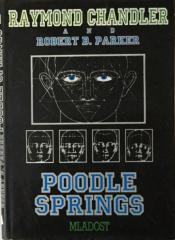
Poodle Springs

Poodle Springs

Raymond Chandler, Robert B. Parker
Mladost, 1991.
Croatian. Latin alphabet. Hardcover with dust jacket.
8.52
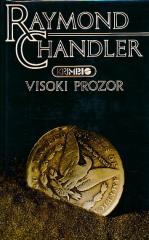
Visoki prozor

Visoki prozor

Raymond Chandler

The novel High Window, the third in the series about private detective Philip Marlowe, takes place in sunny but corrupt Los Angeles. Marlowe, a cynic at heart, navigates through the glitz of Hollywood, where high windows hide falls into the abyss.

Spektar, 1984.
Croatian. Latin alphabet. Hardcover with dust jacket.
8.26
Magična ljubavna kutijica

Magična ljubavna kutijica

Santa Montefiore

The Magic Love Box (2002) follows the life story of Federica Campione, which begins in Vina del Mar, Chile, in the summer of 1982. Montefiore creates an epic story of growth, where the magic is not only in the box, but in the courage to let go of the past

Mozaik knjiga, 2006.
Croatian. Latin alphabet. Hardcover.
7.34
Pripovetke iz levog i desnog džepa

Pripovetke iz levog i desnog džepa

Karel Čapek

These stories deal with different topics, although most deal with different criminal acts, from fraud and fortune-telling to marriage fraud and murder.

Jugoslavijapublik, 1980.
Croatian. Latin alphabet. Hardcover.
5.22
Usta puna zemlje

Usta puna zemlje

Branimir Šćepanović

The novel "Usta puna zemlje" (1970), the masterpiece of the Serbian writer Branimir Šćepanović, is a psychologically in-depth explorer of the limits of the human soul, solitude and existential freedom, reminiscent of Kafka and Camus.

BIGZ, 1987.
Serbian. Latin alphabet. Paperback.
3.98
Deobe

Deobe

Dobrica Ćosić

Deobe is a novel about the tragic division of Serbs into Chetniks and Partisans during World War II. Winner of the NIN Award, it is part of a wider epic trilogy, inspired by Ćosić's experiences and historical documents.

Prosveta, 1963.
Croatian. Latin alphabet. Hardcover with dust jacket.
13.74