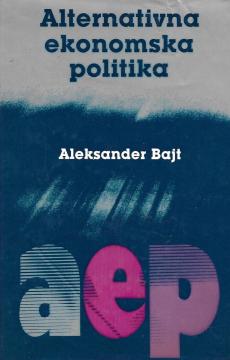
Alternativna ekonomska politika
One copy is available

One copy is available
Are you interested in another book? You can search the offer using our search engine or browse books by category.
In this book of essays, Muharem Bazdulj analyzes how the collapse of Yugoslavia and the wars of the 1990s resonated in Anglo-Saxon literature – from pre-war stereotypes to war and post-war depictions.
A programmatic text in which Đilas, as a senior party ideologist, sets out Marxist-Leninist guidelines for the teaching and writing of national (Yugoslav) history as a means of education and ideological struggle.
The book has a scientific-documentary character and is often used as a source in the study of political history and social movements in the former Yugoslavia.
The book by Raif Dizdarević, one of the last living actors of Yugoslav diplomacy, presents his reconstruction of the most fateful moment of post-war Yugoslavia – the split with Stalin and the Informburo in 1948–1953.
Amir Duranović's book reconstructs in detail the dramatic year 1966 and the Fourth (Brion) Session of the Central Committee of the Communist Party of Yugoslavia (July 1–2, 1966), at which Aleksandar Ranković, the long-time head of the UDB and vice preside
The generation to which Konstantinović belonged managed to reach an agreement and, had it not been for the Second World War, was on the threshold of establishing liberal democracy in Yugoslavia, whose supporter Konstantinović was.