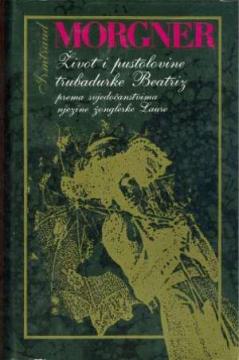
Život i pustolovine trubadurke Beatriz prema svjedočanstvima njezine žonglerke Laure

Život i pustolovine trubadurke Beatriz prema svjedočanstvima njezine žonglerke Laure

Irmtraud Morgner

The novel combines elements of socialist realism, feminism, and the fantastic. Set in medieval France and East Germany, the novel explores themes of women's emancipation, art, and social struggle through the story of Beatriz and Laura.

Beatriz, a historical figure, comes to life as a troubadour who awakens in modern GDR after a century of sleep, confronting capitalist and socialist contradictions. Laura, her juggler, narrates Beatriz's adventures, combining medieval poetry with political and feminist themes. The novel follows Beatriz's attempt to adapt to the new world, her struggle with patriarchal structures, and her search for artistic freedom. Through a satirical and ironic tone, Morgner questions gender roles, class struggle, and the role of art in society.

The structure of the novel is layered, combining historical documents, poetry, and fiction, with an emphasis on a dialogue between the past and the present. Beatriz and Laura symbolize women's resistance against social constraints, while the novel deals with issues of power, identity, and utopian ideals. Morgner uses fantastical elements to criticize social norms, making the work a significant example of feminist literature from the GDR.

Original title
Leben und Abenteuer der Trobadora Beatriz nach Zeugnissen ihrer Spielfrau Laura
Translation
Nedeljka Paravić
Editor
Mirjana Buljan
Dimensions
21 x 14 cm
Pages
504
Publisher
Globus, Zagreb, 1985.
 
Latin alphabet. Hardcover with dust jacket.
Language: Croatian.

Two copies are available

Copy number 1

Condition:Used, excellent condition

Copy number 2

Condition:Used, excellent condition
 

Are you interested in another book? You can search the offer using our search engine or browse books by category.

You may also be interested in these titles

QB VII

QB VII

Leon Uris

QB VII is a dramatic courtroom novel that highlights the events leading up to the libel trial in four parts. The novel was Uris' second consecutive #1 New York Times bestseller and third overall.

Otokar Keršovani, 1982.
Croatian. Latin alphabet. Hardcover with dust jacket.
5.34 - 5.42
Dvori od oraha

Dvori od oraha

Miljenko Jergović

"The Walnut Courts" (2003) is one of Miljenko Jergović's most famous and moving novels. This novel remains one of the most important literary testimonies about the 20th century in the Balkans and the cost of forgetting.

Dani, 2005.
Croatian. Latin alphabet. Paperback.
12.38
Begunac

Begunac

Lajos Zilahy

Lajoš Zilahi, Hungarian writer, left a deep mark in literature. His book "The Fugitive" from 1977 is one of his best works.

Bratstvo-Jedinstvo, 1977.
Serbian. Latin alphabet. Hardcover.
5.644.51
Poslednji živi mrtvac

Poslednji živi mrtvac

Branislav Glumac
Zora, 1965.
Croatian. Latin alphabet. Hardcover with dust jacket.
0.99
Devojka iz noćnog autobusa

Devojka iz noćnog autobusa

Jovan Maksimović
Kosmos, 1962.
Serbian. Latin alphabet. Paperback.
4.99
Fiškal / Među žabarima

Fiškal / Među žabarima

Ante Kovačić

"Fiškal" is a novel by Ante Kovačić, which deals with themes of identity, social change, and the conflict between tradition and modernity.

Mladost, 1978.
Croatian. Latin alphabet. Hardcover with dust jacket.
5.32