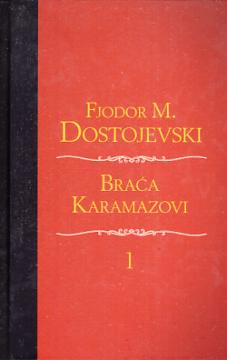

Braća Karamazovi

Braća Karamazovi

Fjodor Mihajlovič Dostojevski

The Brothers Karamazov is the last novel of the Russian genius Fyodor Mikhailovich Dostoyevsky, which he completed less than three months before his death.

The influence of this novel, which is considered his greatest work, has not ceased to weaken since its publication. Striking, strong reflections on faith, the meaning of life, love and morality deeply permeate The Brothers Karamazov, as well as low passions, greed, sadness, jealousy and humor.

After the depraved landowner Fyodor Pavlovich was found dead, the life of his three sons changed irrevocably: Mitya, his firstborn, himself a passionate soul possessed by earthly pleasures, immediately fell under suspicion of parricide. The second son Ivan is an intellectual whose mental storms lead to a complete breakdown. Alyoš's third son is a spiritual young man who is doing his best to heal deep family divisions, and there is also the dubious character of their unrecognized half-brother Smerdyakov.

Describing the judicial investigation and the trial that follows the murder, this supreme masterpiece conjures up a world in which the boundaries between innocence and corruption, good and evil, are completely blurred, and where faith in humanity is put to the most severe test. Deeply plunging into the human soul and delineating the psychological portraits of his characters, Dostoevsky fundamentally questions the most important topics of human existence, creating his best work and one of the most precious works of world literature.

Original title
Братья Карамазовы
Translation
Zlatko Crnković
Graphics design
Halid Malla
Dimensions
20 x 13.5 cm
Pages
831
Publisher
Globus, Zagreb, 2004.
 
Latin alphabet. Hardcover.
Language: Croatian.
ISBN
9-53-716051-3

Two copies are available

Copy number 1

Condition:Unused

Copy number 2

Condition:Unused
 

Are you interested in another book? You can search the offer using our search engine or browse books by category.

You may also be interested in these titles

Ujakov san / Poniženi i uvrijeđeni

Ujakov san / Poniženi i uvrijeđeni

Fjodor Mihajlovič Dostojevski

Both works reflect Dostoevsky's early phase, with a focus on social criticism, psychological analysis and moral dilemmas, foreshadowing the themes of his later masterpieces.

Znanje, 1982.
Croatian. Latin alphabet. Hardcover.
13.2610.61
Zapisi iz mrtvog doma / Zimske bilješke o ljetnim dojmovima / Zapisi iz podzemlja

Zapisi iz mrtvog doma / Zimske bilješke o ljetnim dojmovima / Zapisi iz podzemlja

Fjodor Mihajlovič Dostojevski

Notes from a Dead Home (1860-1862) - a novel based on the author's imprisonment in Siberia. Winter Notes on Summer Impressions (1863) - an essay from a trip to Europe in 1862. Notes from the Underworld (1864) is a philosophical novel about a man torn by i

Znanje, 1982.
Croatian. Latin alphabet. Hardcover.
16.56
Osuđen na uspjeh

Osuđen na uspjeh

Hans Hellmut Kirst

In this work, the character of police inspector Keller appears for the first time, who fights crime with unusual methods.

Prosveta, 1987.
Croatian. Latin alphabet. Paperback.
4.98
Kraljev gambit

Kraljev gambit

Branka Slijepčević
Znanje, 1988.
Croatian. Latin alphabet. Hardcover with dust jacket.
4.22
Stari obiteljski vrt

Stari obiteljski vrt

Giorgio Bassani

Giorgio Bassani's Italian historical novel, published in 1962, chronicles the relationship between the narrator and the children of the Finzi-Contini family from the rise of Benito Mussolini to the beginning of World War II.

Mladost, 1964.
Croatian. Latin alphabet. Hardcover with dust jacket.
4.22 - 4.28
Čovek od gipsa

Čovek od gipsa

Joseph Kessel

The novel, whose original title is L'Homme de plâtre, explores complex human destinies through the story of a protagonist whose life symbolically reflects fragility and vulnerability, like plaster.

Minerva, 1987.
Serbian. Latin alphabet. Hardcover.
4.64