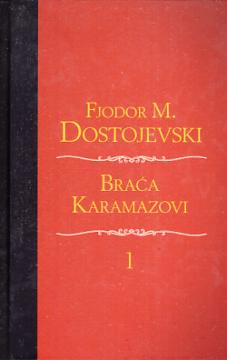

Braća Karamazovi

Braća Karamazovi

Fjodor Mihajlovič Dostojevski

The Brothers Karamazov is the last novel of the Russian genius Fyodor Mikhailovich Dostoyevsky, which he completed less than three months before his death.

The influence of this novel, which is considered his greatest work, has not ceased to weaken since its publication. Striking, strong reflections on faith, the meaning of life, love and morality deeply permeate The Brothers Karamazov, as well as low passions, greed, sadness, jealousy and humor.

After the depraved landowner Fyodor Pavlovich was found dead, the life of his three sons changed irrevocably: Mitya, his firstborn, himself a passionate soul possessed by earthly pleasures, immediately fell under suspicion of parricide. The second son Ivan is an intellectual whose mental storms lead to a complete breakdown. Alyoš's third son is a spiritual young man who is doing his best to heal deep family divisions, and there is also the dubious character of their unrecognized half-brother Smerdyakov.

Describing the judicial investigation and the trial that follows the murder, this supreme masterpiece conjures up a world in which the boundaries between innocence and corruption, good and evil, are completely blurred, and where faith in humanity is put to the most severe test. Deeply plunging into the human soul and delineating the psychological portraits of his characters, Dostoevsky fundamentally questions the most important topics of human existence, creating his best work and one of the most precious works of world literature.

Original title
Братья Карамазовы
Translation
Zlatko Crnković
Graphics design
Halid Malla
Dimensions
20 x 13.5 cm
Pages
831
Publisher
Globus, Zagreb, 2004.
 
Latin alphabet. Hardcover.
Language: Croatian.
ISBN
9-53-716051-3

No copies available

The last copy was sold recently.


Are you interested in another book? You can search the offer using our search engine or browse books by category.

You may also be interested in these titles

Ujakov san / Poniženi i uvrijeđeni

Ujakov san / Poniženi i uvrijeđeni

Fjodor Mihajlovič Dostojevski

Oba djela odražavaju Dostojevskijevu ranu fazu, s fokusom na društvenu kritiku, psihološku analizu i moralne dileme, najavljujući teme njegovih kasnijih remek-djela.

Znanje, 1982.
Croatian. Latin alphabet. Hardcover.
13.26
Mladac

Mladac

Fjodor Mihajlovič Dostojevski

„Mladić“ (1875) Fjodora Dostojevskog je složen roman o odrastanju, moralnim borbama i društvenim sukobima u Rusiji 19. veka. Roman, iako manje poznat, snažno prikazuje unutrašnju borbu i društvene tenzije, sa naglaskom na veri i pomirenju.

Znanje, 1982.
Croatian. Latin alphabet. Hardcover.
11.50
Selo Stepančikovo

Selo Stepančikovo

Fjodor Mihajlovič Dostojevski

"The Village of Stepanchikovo" is a humorous novel by Dostoyevsky, first published in 1859. This novel, which differs from the later, darker works of the author, is a satirical critique of social relations and human weaknesses.

Svjetlost, 1962.
Serbian. Latin alphabet. Paperback.
4.22 - 4.76
Kreutzerova sonata, Hadži-Murat

Kreutzerova sonata, Hadži-Murat

Lav Nikolajevič Tolstoj

Kreutzer's sonata belongs to those works of Tolstoy that the writer adapted in many ways to his view on moral issues, on marital morality above all.

Civitas, 2004.
Croatian. Latin alphabet. Paperback.
4.98
Tri mušketira 1-2

Tri mušketira 1-2

Alexandre Dumas

Dumas' version of the story depicts the adventures of d'Artagnan and his friends from 1625 to 1628.

Epoha, 1966.
Croatian. Latin alphabet. Hardcover with dust jacket.
The book consists of two volumes
9.48
Stotina godina (antikronika)

Stotina godina (antikronika)

Dario Harjaček

The novel One Hundred Years by Dario Harjaček provides a panoramic view of Trešnjevka and its inhabitants through a century of changes, ideologies, and human destinies – a mosaic of Zagreb in which life, art, and history intertwine.

Oceanmore, 2025.
Croatian. Latin alphabet. Paperback.
13.42