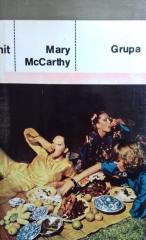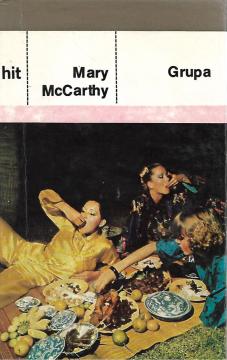
Grupa

Grupa

Mary Mccarthy

Mary McCarthy's group follows eight young women after they graduate from Vassar. The novel depicts their loves, marriages, careers, and disappointments, as well as the position of women in American society in the 1930s.

The Group is the most famous novel by American writer Mary McCarthy. The story begins in 1933 at the wedding of Kay Strong, one of eight friends who have just graduated from the prestigious women's college Vassar. This event brings together a group of young women who believe that their education has given them the opportunity to live an independent and fulfilling life. However, the years that follow will show how much their ideals are in conflict with the reality of American society at the time.

The novel follows the destinies of Kay, Priss, Lakey, Polly, Helena, Libby, Dottie and Pokey. Each of them embarks on a different path in life. Some enter marriages full of expectations, others try to build careers, while some seek personal freedom outside of traditional social norms. Through their interconnected stories, the author depicts love affairs, marital problems, sexuality, motherhood, social prejudices and professional challenges.

Kay's marriage to the charismatic but emotionally unstable Harald Petersen takes center stage. Their relationship gradually uncovers the difference between romantic expectations and the reality of living together. At the same time, the other members of the group also face disappointments that arise from the conflict between personal ambitions and social expectations.

McCarthy openly addresses topics that were controversial at the time of the novel's publication, including sexual relations, contraception, psychological problems, and the position of women in society. The Group is at once a social document of a generation and a compelling novel about friendship, growing up, and the search for identity in a rapidly changing world.

Original title
The Group
Translation
Vjera Balen-Heidl
Editor
Zlatko Crnković
Graphics design
Alfred Pal
Dimensions
20 x 12 cm
Pages
424
Publisher
Znanje, Zagreb, 1987.
 
Latin alphabet. Hardcover with dust jacket.
Language: Croatian.

Multiple copies are available

Copy number 1

Condition:Used, excellent condition

Copy number 2

Condition:Used, excellent condition

Copy number 3

Condition:Used, excellent condition
 

Are you interested in another book? You can search the offer using our search engine or browse books by category.

You may also be interested in these titles

Graditelj svratišta

Graditelj svratišta

Ivan Aralica

The inn builder is a realistic historical novel, in the tradition of Andrić, but with elements of fantasy that connect Aralica with the oral Croatian literary word, but also with the fantastic literature of Gabriel García Marques, for example.

Znanje, 1987.
Croatian. Latin alphabet. Hardcover with dust jacket.
7.26
Povijest pornografije

Povijest pornografije

Goran Tribuson

At the age of forty, Goran Tribuson published a book that will permanently win over the readership. The novel "History of Pornography" and the year 1988 will be on every list of anthology readings and important years for contemporary Croatian prose.

Znanje, 1988.
Croatian. Latin alphabet. Hardcover with dust jacket.
7.24
Naivci

Naivci

Ivan Kušan

This is a humorous and satirical story about life in a small Dalmatian town, told through the perspective of a naive but insightful narrator.

Znanje, 1975.
Croatian. Latin alphabet. Hardcover with dust jacket.
3.64
Eva Luna

Eva Luna

Isabel Allende

Eva Luna is a novel about a poor storyteller who weaves lives with words, written by Isabel Allende, the founder of Latin American magical realism. Published after the success of The House of the Spirits, this whirlwind of adventure combines love, revolut

Znanje, 1990.
Croatian. Latin alphabet. Hardcover with dust jacket.
8.36
Put u Jajce

Put u Jajce

Edvard Kocbek

In Put u Jajce, Edvard Kocbek provides personal and political testimony about key moments in Yugoslav history. The book is based on Kocbek's memories from the Second World War, especially the trip to Jajce in 1943.

Znanje, 1978.
Croatian. Latin alphabet. Hardcover with dust jacket.
8.38
Rakova djeca

Rakova djeca

Pavao Pavličić

Rakov's children are a tense read in which the editor of the black chronicle, Ivo Remetin, visits a friend who died in a traffic accident and becomes involved in an intriguing search for the killer of cancer patients.

Znanje, 1988.
Croatian. Latin alphabet. Hardcover with dust jacket.
5.32