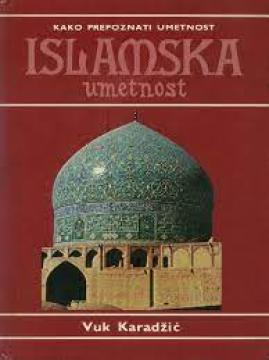
Kako prepoznati umetnost : Islamska umetnost

Kako prepoznati umetnost : Islamska umetnost

Translation
Milica Starčević
Editor
Gordana Petrović
Dimensions
20 x 13 cm
Pages
64
Publisher
Vuk Karadžić, Beograd, 1980.
 
Latin alphabet. Hardcover.
Language: Serbian.

One copy is available

Condition:Used, excellent condition
 

Are you interested in another book? You can search the offer using our search engine or browse books by category.

You may also be interested in these titles

Muzeji svijeta - Muzej lijepih umjetnosti Boston

Muzeji svijeta - Muzej lijepih umjetnosti Boston

This book provides an interesting insight into the Museum of Fine Arts in Boston.

Mladost, 1978.
Croatian. Latin alphabet. Hardcover with dust jacket.
10.98
Dimitrije : 25 godina nadrealizma 1970 - 1995

Dimitrije : 25 godina nadrealizma 1970 - 1995

Tonko Maroević, Goran Blagus
Trident d.o.o., 1995.
Croatian. Latin alphabet. Paperback.
6.504.55
Muzeji svijeta - Muzej umjetnosti – Sao Paulo

Muzeji svijeta - Muzej umjetnosti – Sao Paulo

The museum in Sao Paulo is known as the largest and most important museum of Western art in Latin America.

Mladost, 1978.
Croatian. Latin alphabet. Hardcover with dust jacket.
10.72
Muzeji svijeta - Vatikanski muzeji Rim

Muzeji svijeta - Vatikanski muzeji Rim

The Vatican Museums are one of the largest and oldest museums in the world, located in the Vatican Palace. With more than 1400 rooms, these museums form an extremely important museum complex.

Mladost, 1970.
Croatian. Latin alphabet. Hardcover with dust jacket.
7.56 - 10.84
Povijest umjetnosti V: Duh oblika

Povijest umjetnosti V: Duh oblika

Élie Faure

One of the most important works in the field of art history. Through this work, Faure gave a unique and personal view of the development of artistic creation, connecting it with social, historical and philosophical circumstances.

Naprijed, 1959.
Croatian. Latin alphabet. Hardcover with dust jacket.
7.98 - 8.26
Kodovi identiteta

Kodovi identiteta

Leonida Kovač's discourse is explicit and direct, almost bodily. It fills and disrupts space. Her theory mimics the work of the performative, it is active. It takes place in one moment and one place of utterance/pronunciation.

Meandar, 2001.
Croatian. Latin alphabet. Paperback.
7.74