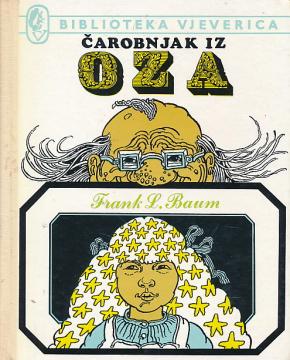
Čarobnjak iz Oza

Čarobnjak iz Oza

Lyman Frank Baum

To return home, Dorothy sets off on a journey to the Emerald City, home to the powerful Wizard of Oz, the only one she believes can help her. She is joined on this journey by three unusual friends: the Scarecrow who wants a brain, the Tin Woodman who wants a heart, and the Cowardly Lion who longs for courage. Each of them believes that the Wizard can give them what they lack. Together, they go through various trials and obstacles, and along the way they learn an important life lesson - that what they are looking for is already within them.

When they finally reach the Emerald City, they discover that the Wizard is not a miraculous being, but an ordinary man who uses tricks and illusions to create the illusion of power. However, with his help, each of the heroes comes to self-knowledge. Dorothy, with the help of magic shoes, manages to find her way home, realizing that there is "nowhere like home".

“The Wizard of Oz” is a beautiful story, and the author himself classified it as a modern fairy tale. We must immediately keep in mind that the adjective modern in this context fits this fairy tale very well, because even though more than a hundred years have passed since its publication, it still proudly retains that adjective. Namely, when it was published, it was already different in many ways from the fairy tales written by the authors of that time, the Brothers Grimm and Charles Perrault.

When he wrote the fairy tale, the author believed that modern times were looking for some new magical stories that would delight children and that would not involve ghosts, fairies, or any other scary events. He wanted to entertain children and keep the joy in them at all times, leaving out the sadness. He also stated this in the preface to the book “The Wizard of Oz”.

Titel des Originals
Wizard of Oz
Übersetzung
Marija Salečić
Editor
Vera Barić
Illustrationen
Zlatko Bourek
Maße
21 x 17 cm
Seitenzahl
151
Verlag
Mladost, Zagreb
 
Auflage: 4.000 Exemplare
 
Latein Schrift. Hardcover.
Sprache: Kroatisch.
ISBN
8-60-500581-5

Weitere Exemplare sind verfügbar

Kopiennummer 1

Zustand:Gebraucht, in ausgezeichnetem Zustand
Zum Warenkorb hinzugefügt!

Kopiennummer 2

Zustand:Gebraucht, in ausgezeichnetem Zustand
Zum Warenkorb hinzugefügt!

Kopiennummer 3

Zustand:Gebraucht, in ausgezeichnetem Zustand
Zum Warenkorb hinzugefügt!
 

Interessieren Sie sich für ein anderes Buch? Sie können das Angebot über unsere Suchmaschine suchen und finden oder Bücher nach Kategorien durchsuchen.

Diese Titel könnten Sie auch interessieren

Čarobni zeleni kišobran

Čarobni zeleni kišobran

Antoaneta Klobučar

This is an interesting story about a wandering magic umbrella that saves its current - alone, sad, mournful, dissatisfied, frowning - owners from the rain, but even more so - from dissatisfaction, unhappiness, sadness.

Sipar, 2018.
Kroatisch. Latein Schrift. Hardcover.
6,31 - 8,54
Maksove šumotvorine

Maksove šumotvorine

Vjekoslava Huljić
Mozaik knjiga, 2002.
Kroatisch. Latein Schrift. Taschenbuch.
5,80
Tatina medalja

Tatina medalja

Melita Rundek

"Dad's Medal" is a short, imaginative, concise story about the relationship between parents and children, in which we see the problem, rebellion, acceptance and resolution of an unsatisfactory relationship.

Sipar, 2008.
Kroatisch. Latein Schrift. Hardcover.
5,98 - 7,64
Neka bude taj dan

Neka bude taj dan

Biljana Čučak

If you catch a goldfish, it will grant you three wishes! In the story Let It Be That Day, we meet the goldfish and her mischievous and playful brother, the goldfish, who, due to his recklessness, leads to...

Sipar, 2020.
Kroatisch. Latein Schrift. Hardcover.
5,98 - 11,98
Pepeljuga, Kuća malena, Pedro

Pepeljuga, Kuća malena, Pedro

Walt Disney

All three stories are gentle, educational, and have a happy ending – ideal for children aged 4–10.

Mladinska knjiga Založba, 1987.
Kroatisch. Latein Schrift. Hardcover.
9,98
Zlatni ključić

Zlatni ključić

Aleksej N. Tolstoj

The novel represents Tolstoy's adaptation of Pinocchio by Carlo Collodi; he got the idea for the novel as a child, when he was read only the first part of the book, so he invented the rest himself.

Veselin Masleša, 1985.
Kroatisch. Latein Schrift. Hardcover.
3,26 - 8,66