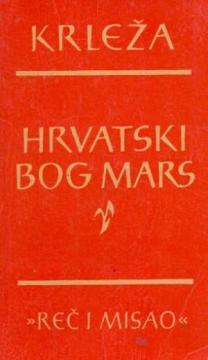

Hrvatski bog Mars

Hrvatski bog Mars

Miroslav Krleža

The Croatian god Mars brings seven anti-war novels in which Krleža portrays war as a cruel, senseless machinery that destroys the "little man", exposing the hypocrisy of militarism and myths about heroism.

In the collection “The Croatian God Mars”, Miroslav Krleža, through seven powerful short stories, depicts war from the perspective of ordinary home guards – hungry, exhausted and lost in a system that does not recognize their humanity or voice. Instead of heroism, war appears as a cold, bureaucratized mechanism that grinds people down due to wrong orders, ideological blindness and national myths.

Each short story opens up a different aspect of this experience: the hospital hell in Barrack Five Be, the grotesque mobilization in Three Home Guards, the mindless slaughter of the Battle of Bistrica Lesna, the fate of ordinary soldiers who die without knowing why. Symbolically, the “Croatian God Mars” represents the bloody anti-deity of war who rules over the province that unconditionally serves another empire.

Krleža’s style is sharp, sarcastic and deeply compassionate: he denounces militarism and moral illusions, but does not condemn people – only the system that pushes them to ruin. That is why The Croatian God Mars remained one of the strongest anti-war works of Croatian literature, brutally honest and tragically recognizable even outside the historical framework in which it was created.

Graphics design
Janko Krajšek
Dimensions
17.5 x 10.5 cm
Pages
120
Publisher
Rad, Beograd, 1965.
 
Distribution: 50,000 copies
 
Latin alphabet. Paperback.
Language: Serbian.

One copy is available

Condition:Used, good condition (visible signs of use)
Damages or inconvenience notice:
  • Blago oštećenje korica
  • Oštećeni listovi
  • Požutjeli listovi
 

Are you interested in another book? You can search the offer using our search engine or browse books by category.

You may also be interested in these titles

Izabrane pjesme

Izabrane pjesme

Miroslav Krleža

Ovaj izbor Krležinih pjesma presjek je njegove cjelokupne poezije (osim Simfonija i Balada Petrice Kermpuha), uključujući i stihove koji čine sastavni dio širih proznih cjelina čime se pokušala naglasiti povezanost Krležine poezije i proze.

Matica hrvatska, 1963.
Croatian. Latin alphabet. Hardcover with dust jacket.
9.99
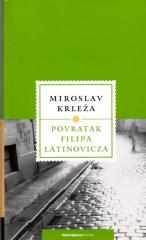
Povratak Filipa Latinovicza

Povratak Filipa Latinovicza

Miroslav Krleža

Povratak Filipa Latinovicza jedan je od najpoznatijih romana Miroslava Krleže. Ovaj roman značajan je u našoj književnosti jer se smatra prvim hrvatskim u potpunosti modernim romanom.

Večernji list, 2004.
Croatian. Latin alphabet. Hardcover with dust jacket.
5.52 - 5.56
Sikamora

Sikamora

Goran Samardžić

"Sikamura" is a collection that does not offer clear answers, but rather encourages the reader to interpret and reflect, making it demanding but significant in the context of contemporary literature.

Bosanska knjiga, 1997.
Croatian. Latin alphabet. Paperback.
5.98
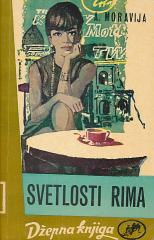
Svetlosti Rima

Svetlosti Rima

Alberto Moravia

Through these stories, Moravia explores themes of social inequality, the struggle for survival, and human frailty, portraying them with a mix of humor, irony, and realistic observation.

Svjetlost, 1965.
Serbian. Latin alphabet. Paperback.
3.82 - 3.92
Inšallah Madona, inšallah

Inšallah Madona, inšallah

Miljenko Jergović

Inšalh, Madonna, Inšalah by Miljenko Jergović is a collection of stories whose richness of motifs and emotions branches out like carved ivory – in each story a story, in each destiny an entire world.

Durieux, 2004.
Croatian. Latin alphabet. Paperback.
16.32
Prvo šišanje

Prvo šišanje

Bohumil Hrabal

The First Haircut, a short story written in 1970 and published in 1976, is the first in a series of prose pieces by Bohumil Hrabal describing Nymburk, the town where he spent his childhood. In 1981, The First Haircut was adapted for the screen by Jiry Men

24 sata, 2007.
Croatian. Latin alphabet. Paperback.
7.245.43