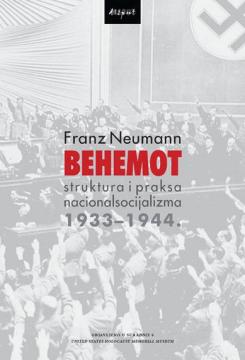
Behemot : struktura i praksa nacionalsocijalizma

Behemot : struktura i praksa nacionalsocijalizma

Franz Neumann

The book presents a structural analysis of the Third Reich through a theoretical and historical understanding of German National Socialism as an ideology, movement and order. Hitler's charismatic personality as a leader, which he preserved until the very

A classic account of the functioning of the government in Nazi Germany, which appeared in a Croatian translation only sixty years later. Like his distant predecessor Thomas Hobbes, who titled his main work after the monster Leviathan, the enemy of power and order, Neumann - also a great political thinker - titled his book after the name of Behemoth, the enemy of chaos, Leviathan's biblical rival.

The huge study "Behemoth" is the result of Neumann's intensive theoretical research into the economic and political roots of totalitarianism in modern industrial society, that is, the identification of the assumptions that enabled the emergence of National Socialism and its takeover of power.

Neumann analyzes the National Socialist system on the basis of rich empirical material as a chaotic system, as a negation of the state, a situation of lawlessness, disorder and anarchy, with a pronounced ambition to establish its hegemony over a vast territory. The book's provocative and controversial central thesis is that the Third Reich did not express a consistent ideology or have a coherent structure. Contrary to superficial depictions of the National Socialist state as a monolithic organization, Neumann shows that it was actually, in a sinister way, pluralistic and that the political will was formed in it through the wild competition of the most powerful social lobbies.

Naslov izvornika
Behemoth
Prijevod
Damjan Lalović
Dimenzije
24 x 17 cm
Broj strana
595
Nakladnik
Disput, Zagreb, 2012.
 
Latinica. Broširano.
Jezik: Hrvatski.

Nema primjeraka u ponudi

Poslednji primjerak je nedavno prodan.

 

Zanima Vas i neka druga knjiga? Možete pretražiti našu ponudu pomoću tražilice ili prelistati knjige po kategorijama.

Možda će Vas zanimati i ovi naslovi

Tipovi prirodnog prava

Tipovi prirodnog prava

Franz Neumann
Dosije, 2013.
Srpski. Latinica. Broširano.
4,99
Povratak iz Gulaga: Tajni referat Hruščova

Povratak iz Gulaga: Tajni referat Hruščova

Karlo Štajner

A sequel to his memoir 7000 Days in Siberia, in which he describes his twenty-year imprisonment in Soviet gulags. The book delves into his experiences in the camps, providing additional insights into Steiner's life and reflections on communist ideals.

Globus, 1986.
Hrvatski. Latinica. Tvrde korice s ovitkom.
10,76 - 11,24
Sam protiv njih

Sam protiv njih

Roman Leljak

A non-fiction work by a Slovenian investigator of the UDB archives. The author, a former KOS employee, left the army after learning about the crimes of the Yugoslav army during the war and the post-war period, and dedicated himself to exposing the secret

Vlastita naklada, 1990.
Hrvatski. Latinica. Broširano.
16,42
Projekt Guevara: Snovitim stazama svjetske revolucije

Projekt Guevara: Snovitim stazama svjetske revolucije

Gerd Koenen

This book is a biography of the historical figure and icon of the twentieth century, Ernesto Che Guevara - in light of his project of a world revolution, which Koenen, after Bruce Chatwin, will call dream paths.

Durieux, 2011.
Hrvatski. Latinica. Tvrde korice s ovitkom.
17,62
Kao suza u okeanu I-II

Kao suza u okeanu I-II

Manes Sperber

A trilogy by Austrian-French writer and psychologist Manès Sperber, which, through three novels – "Dust and Ashes", "In the Vortex" and "Memories and Shadows" – explores the themes of totalitarianism, ideological blindness and human suffering during the t

Matica srpska, 1997.
Srpski. Ćirilica. Broširano.
Knjiga se sastoji od dva toma
9,38
Kroz tajni arhiv Udbe

Kroz tajni arhiv Udbe

Nikola Milovanović

The author of this book describes the fate of the main enemies of the Yugoslav communists in the last stage of the war, as well as their attempts to prevent the consolidation of communist power in Yugoslavia in the first post-war years.

Sloboda, 1986.
Hrvatski. Latinica. Tvrde korice s ovitkom.
Knjiga se sastoji od dva toma
15,26