Poviest hrvatske književnosti do narodnog preporoda
Antiquität
Ein rares Buch

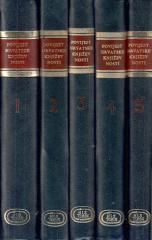
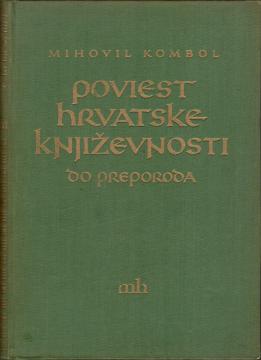
Poviest hrvatske književnosti do narodnog preporoda

Mihovil Kombol

An overview of the development of Croatian literature from the Middle Ages to the National Revival. Kombol presents the main authors, genres, and literary movements that shaped the foundation of the national tradition.

History of Croatian Literature to the Renaissance is one of the most important overviews of older Croatian literature. Kombol, an already established scholar at the time, covers literary development from the Middle Ages to the very threshold of the Croatian National Revival, connecting domestic texts with the European traditions of humanism, the Renaissance, the Baroque, and the Enlightenment. The book provides a systematic and clearly organized picture of the most important authors, poetics, and cultural centers – from the Glagolitic circle and the Dubrovnik Renaissance to continental pre-Renaissance efforts.

Mihovil Kombol (1875–1955) was one of the key Croatian literary historians of the 20th century. He studied Slavic and German studies in Vienna, where he received his doctorate with a thesis on the Čakavian dialect of the Croatian littoral. He worked as a high school teacher, editor, and compiler of numerous anthologies, and from 1943 he taught older Croatian literature at the Faculty of Philosophy in Zagreb. He is known for his exceptional philological precision, broad comparative insights, and contribution to the interpretation of the Dubrovnik-Dalmatian Renaissance.

Although the work is scientifically and politically unaccented, the very fact of its publication during the NDH influenced its post-war reception. It was not directly banned, but for decades it was rarely mentioned, and in academic life it was partially suppressed under the ideological shadow of the time in which it was published. Kombol was not personally politically exposed, but his employment at the University in 1943 and his publications during the war years made him a "sensitive author" in post-war Yugoslavia. Despite this, later literary historians recognized the lasting value of the work, and Kombol remained one of the key authors in Croatian literary historiography.

The book is today appreciated as a fundamental account of pre-Renaissance literature, important for its clear structure, precision, and scientific reliability, but also as a document of a time in which science and politics often dangerously intersected.

Titelseite
Rudolf Schlick
Maße
27 x 17 cm
Seitenzahl
439
Verlag
Matica hrvatska, Zagreb, 1945.
 
Latein Schrift. Hardcover.
Sprache: Kroatisch.

Angeboten wird ein Exemplar

Zustand:Gebraucht, in ausgezeichnetem Zustand
Zum Warenkorb hinzugefügt!
 

Interessieren Sie sich für ein anderes Buch? Sie können das Angebot über unsere Suchmaschine suchen und finden oder Bücher nach Kategorien durchsuchen.

Diese Titel könnten Sie auch interessieren

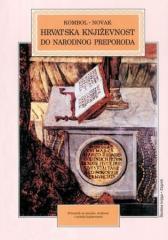
Hrvatska književnost do narodnog preporoda

Hrvatska književnost do narodnog preporoda

Mihovil Kombol, Slobodan P. Novak
Školska knjiga, 1992.
Kroatisch. Latein Schrift. Taschenbuch mit Einband.
9,94 - 10,00
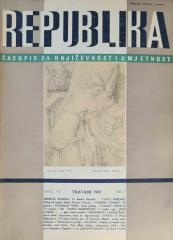
Republika 1950/4

Republika 1950/4

Mihovil Kombol, Cvito Fisković, Dobriša Cesarić, Stanislav Šimić, Vladan Desnica, Ranko Marinkovi...
Republika, 1950.
Kroatisch. Latein Schrift. Taschenbuch.
6,82
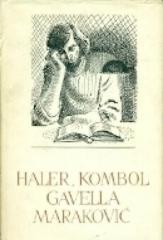
Pet stoljeća hrvatske književnosti #86 - Eseji, studije, kritike

Pet stoljeća hrvatske književnosti #86 - Eseji, studije, kritike

Albert Haler, Mihovil Kombol, Branko Gavella, Ljubomir Maraković

Five Centuries of Croatian Literature (PSHK) is the largest publishing project in the history of Croatian literature.

Zora, Matica hrvatska, 1971.
Kroatisch. Latein Schrift. Fester Einband mit Schutzumschlag.
5,464,78 - 5,985,46
Karavan savršenih

Karavan savršenih

Predrag Jirsak
Mladost, 1964.
Kroatisch. Latein Schrift. Fester Einband mit Schutzumschlag.
4,59 - 6,28
Truba za Bleiburg

Truba za Bleiburg

Marino Zurl

Marino Zurl (1929–2006), a Croatian writer and publicist, writes in his novel Trumpet for Bleiburg about one of the most controversial and taboo topics in Croatian history – the Bleiburg Massacre and the Stations of the Cross in 1945.

Brkić i sin, 1997.
Kroatisch. Latein Schrift. Taschenbuch.
14,68
Začuđeni svatovi

Začuđeni svatovi

Eugen Kumičić

The novel "The Surprised Wedding Party" tells the story of the unrequited love of Antonio, a poor young man, for the beautiful daughter of a fisherman, Marija. Along with the aforementioned love story, another plot stands out, and that is the secret love

Školska knjiga, 1982.
Kroatisch. Latein Schrift. Taschenbuch.
Das Buch besteht aus zwei Bänden
2,00 - 5,64