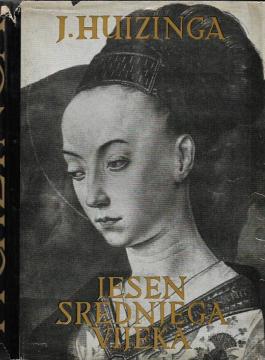
Jesen srednjega vijeka
Rijetka knjiga

Jesen srednjega vijeka

Johan Huizinga

The classic book by the prominent Dutch historian Johan Huizinga (1872-1945) “The Autumn of the Middle Ages” was published a hundred years ago, in 1919, and remains one of the most famous works on the Middle Ages to this day.

The Autumn of the Middle Ages is a classic historiographical work by the Dutch historian Johan Huizinga, which depicts cultural and social life in France and the Netherlands during the 14th and 15th centuries. Rather than focusing on political events, Huizinga analyzes the mentality, symbolism, and everyday life of people towards the end of the Middle Ages.

Huizinga portrays the period as a time of decadence and emotional over-emphasis, dominated by pessimism, mysticism, and intense religiosity. The art and literature of the period are permeated with images of death, moral sermons, and rituals that reflect a deep insecurity and a sense of the end of the world.

The author argues that the end of the Middle Ages was not an abrupt break, but a slow “withering away” of old values, as seen through the culture of courtly customs, chivalric ideals, and ceremonialism. Although often perceived as a dark age, Huizinga shows that it was also a period of great sensitivity, imagination, and spiritual intensity.

The work is pioneering in cultural history and, although controversial, remains essential reading for understanding the transition from the Middle Ages to the Renaissance.

Naslov izvornika
Herfsttij der Middeleeuwen
Prijevod
Drago Perković
Urednik
Grgo Gamulin
Naslovnica
Valerija Pavić
Dimenzije
22 x 16 cm
Broj strana
405
Nakladnik
Matica hrvatska, Zagreb, 1964.
 
Latinica. Tvrde korice s ovitkom.
Jezik: Hrvatski.

Nema primjeraka u ponudi

Poslednji primjerak je nedavno prodan.
 

Zanima Vas i neka druga knjiga? Možete pretražiti našu ponudu pomoću tražilice ili prelistati knjige po kategorijama.

Možda će Vas zanimati i ovi naslovi

Red reči: Lingvistički ogledi, četiri

Red reči: Lingvistički ogledi, četiri

Milka Ivić

The famous Serbian linguist and one of the most influential figures in 20th-century Yugoslav linguistics, in this book continues her series of "Linguistic Reflections" – lucid, erudite essays that combine general linguistics, the Serbian language, and cul

Biblioteka XX vek, 2002.
Srpski. Latinica. Broširano.
7,56
Kriza, a poslije?

Kriza, a poslije?

Jacques Attali

After A Brief History of the Future, Jacques Attali writes a brief history of the present, dissecting the reasons that led to the first global financial crisis, the ways in which it manifests itself, and possible perspectives for the future.

MeandarMedia, 2009.
Hrvatski. Latinica. Broširano.
9,24
Nerezînski beseduâr: rječnik govora Nerezina na otoku Lošinju

Nerezînski beseduâr: rječnik govora Nerezina na otoku Lošinju

Onorato Bonić, Nataša Šprljan, Flavia Zorović

The work Nerezinski beseduâr is a dictionary of the speech of Nerezine on the island of Lošinj, which has almost 12,600 lexicographical entries, and is accompanied by contributions from local phraseology, paremiology and toponymy.

24 sata, 2023.
Hrvatski. Latinica. Tvrde korice.
29,90
Kultura i komunikacija: Logika povezivanja simbola

Kultura i komunikacija: Logika povezivanja simbola

Edmund Leach

In „Kultur und Kommunikation“ untersucht Edmund Leach soziale Beziehungen anhand von Sprache, Ritualen und Symbolen. Er verknüpft die Anthropologie mit der Kommunikationstheorie und zeigt Kultur als ein Bedeutungssystem auf, das menschliches Verhalten prä

Biblioteka XX vek, 1983.
Srpski. Latinica. Broširano.
7,32
Titostalgija

Titostalgija

Mitja Velikonja

The author explores why Tito remains a popular symbol of stability, social security and independence, despite critical views of his regime. The book maps the cultural, political and everyday manifestations of "Titostalgia".

Biblioteka XX vek, 2010.
Srpski. Latinica. Broširano.
7,36
Izvješća iz Tarahumare

Izvješća iz Tarahumare

Ivan Rattkay

The book contains three Latin reports by the Croatian Jesuit, nobleman and explorer Ivan Rattkay (Ratkaj, 1647–1683), born in Ptuj (today Slovenia), sent to the provincial of the Austro-Czech Jesuit province from the mission in northern Mexico.

ArTresor naklada, 1998.
Hrvatski. Latinica. Tvrde korice s ovitkom.
9,56