Opuscula archaeologica IV: Zlatni nakit iz helenističko-ilirske nekropole u Budvi

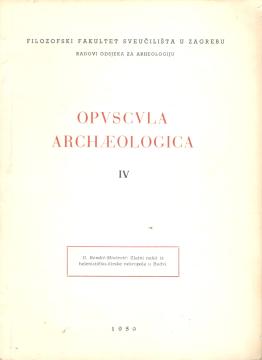
Opuscula archaeologica IV: Zlatni nakit iz helenističko-ilirske nekropole u Budvi

Duje Rendić-Miočević

The article presents a classic analysis of archaeological findings from the Hellenistic period (3rd-2nd century BC) in the necropolis north of ancient Budva (today's Montenegro), discovered in the 1950s.

The author catalogues and describes in detail the gold jewellery from 12 graves: spiral bracelets in the shape of snakes made of thin gold sheet (wt. 10-20 g), earrings with pyramidal designs (upturned pyramids with granulated decorations), circular zoomorphic earrings with lion and bull motifs, fibulae, rings with intaglio and chains with pendants. He analyses the processing techniques (forging, filigree work, granulation), styles (Hellenistic influences with Illyrian variants) and context: the jewellery was found in female and male graves with ceramics, bronze and iron, indicating elite burial rituals. Rendić-Miočević compares it with parallel finds from Glasinac, Trebenište and Greek centres, dating them to the Macedonian phase of Hellenism.

These objects, weighing a total of over 200 g, are rare examples of high-value gold in the Illyrian region, testifying to the wealth of local tribes (probably the Doclea or Labeati). The motifs (snakes as a symbol of protection, zoomorphic elements) reveal a synthesis of Greek influences and autochthonous symbolism, and the quality of the workmanship points to masters from Macedonia or Epirus. The findings confirm Budva as an important commercial and cultural center on the Adriatic.

The work enriches the picture of Illyrian civilization, illustrating Hellenistic acculturation in the Balkans: the spread of Greek art through trade and migration, social hierarchy (jewelry as a status symbol), and ethnic interactions. As one of the first detailed studies of Illyrian gold, it influenced later research (e.g. in Trebenište, Apollonia), helping to reconstruct Balkan routes and the transition from the Iron Age to the Hellenistic Age. It remains a reference for understanding the pre-Roman Adriatic and Illyrian-Greek connections.

Dimenzije
23 x 17 cm
Broj strana
60
Nakladnik
Filozofski fakultet Sveučilišta u Zagrebu, Zagreb, 1959.
 
Latinica. Broširano.
Jezik: Hrvatski.

Jedan primjerak je u ponudi

Stanje:Korišteno, u odličnom stanju
Dodano u košaricu!
 

Zanima Vas i neka druga knjiga? Možete pretražiti našu ponudu pomoću tražilice ili prelistati knjige po kategorijama.

Možda će Vas zanimati i ovi naslovi

Arktička pradomovina Veda

Arktička pradomovina Veda

Bal Gandahar Tilak

The book The Arctic Homeland of the Vedas (1903) by the Indian scholar Tilak proposed the hypothesis that the ancient Aryans, the authors of the Rigveda, originated in the Arctic region. Although controversial, the book remains important in the study of V

NIRO Književne novine, 1987.
Srpski. Latinica. Broširano.
17,56
Povijest #15: Kolonijalna carstva i imperijalizam (1871.-1914.)

Povijest #15: Kolonijalna carstva i imperijalizam (1871.-1914.)

The fifteenth volume of the World History series covers the period from 1871 to 1914, marked by the height of colonialism and imperialism. The book is richly illustrated, providing a comprehensive account of this period of global change and tension.

Europapress holding, 2008.
Hrvatski. Latinica. Tvrde korice.
9,32 - 9,46
Povijest svijeta od početka do danas

Povijest svijeta od početka do danas

Jochen Bleicken, Vladimir Brodnjak
Naprijed, 1976.
Hrvatski. Latinica. Tvrde korice s ovitkom.
26,36 - 29,75
Povijest #5: Kasno Rimsko Carstvo i rani srednji vijek

Povijest #5: Kasno Rimsko Carstvo i rani srednji vijek

Peti svezak obrađuje zadnju fazu u povijesti Rimskog carstva, jačanje Bizanta i njegovo preuzimanje tradicije starog Rima, ali i povijest Europe nakon velike seobe naroda. Knjiga završava s ekspanzijom islama i stvaranjem prvih islamskih država.

Europapress holding, 2007.
Hrvatski. Latinica. Tvrde korice.
7,34 - 7,64
Kratka povijest ljudske rase

Kratka povijest ljudske rase

Michael Cook

Michael A. Cook, Princeton professor of Islamic history, provides an overview of human history from the Neolithic to the fall of the Twin Towers in 2001 in this witty and intelligent synthesis, asking the key question: why did everything happen exactly th

Profil Knjiga, 2009.
Hrvatski. Latinica. Broširano.
16,28
Tajna prepiska Roosevelt - Staljin

Tajna prepiska Roosevelt - Staljin

Franklin Delano Roosevelt, Josif Visarionovič Staljin
Epoha, 1965.
Hrvatski. Latinica. Tvrde korice s ovitkom.
2,99