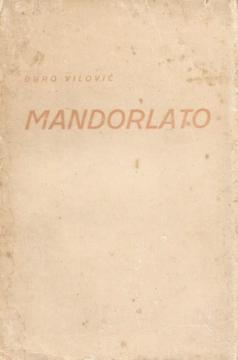
Mandorlato
Antikvitet

Mandorlato

Đuro Vilović

Mandorlato (1924) is a collection of short stories/novellas from the author's early period of work, marked by psychological portraits, erotic motifs, and social criticism, typical of his controversial interwar oeuvre.

Đuro Vilović (1889–1958), one of the most widely read, but also most controversial Croatian writers of the interwar period, published Mandorlato in 1924 in Zagreb. The book belongs to his early novel collections, along with Zagaljene živote (1923) and later Hrvatski sjever i jug (1930).

The title Mandorlato (Italian for almond cake/drink) suggests a bittersweet, exotic or sensual atmosphere, which is in line with Vilović's style, which often combines erotic, psychological and social motifs. The collection contains several short stories that depict human passions, internal conflicts, love and social dramas, often with an autobiographical overtone. Vilović, a former Catholic priest who left the profession, often deals with themes of forbidden love, the hypocrisy of civil morality, sexuality and the conflict of the individual with his environment.

Stylistically, the work moves between realism and psychological prose with naturalistic and fin-de-siècle elements. Vilović writes in a lively, accessible language, often with an emphasis on emotional crises and social criticism, which brought him great popularity with the audience, but also harsh criticism from conservative circles (especially because of the anticlerical motifs in other works). Mandorlato is one of his earlier works, written after leaving the priesthood, when the author intensively dealt with the themes of personal freedom and liberation from old norms.

In the broader context of Vilović's oeuvre, this collection precedes his more famous novels such as Međimurje (1923), Majstora duša (1931) and Tri sata (1935). Like most of his works from the 1920s, Mandorlato reflects the author's tumultuous biography — from rightist and Catholic priest to Yugoslav Unitarian — and his penchant for controversial, provocative topics.

Dimenzije
20 x 14 cm
Broj strana
150
Nakladnik
Tisak jugoslovenske štampe d.d. u Zagrebu, Zagreb, 1924.
 
Latinica. Broširano.
Jezik: Hrvatski.

Jedan primjerak je u ponudi

Stanje:Korišteno, u vrlo dobrom stanju
Oštećenja / nepogodnosti:
  • Slight damage to the cover
Snižena cijena: 7,995,99
Popust od 25% vrijedi do 25.06.2026. 23:59
Dodano u košaricu!
 

Zanima Vas i neka druga knjiga? Možete pretražiti našu ponudu pomoću tražilice ili prelistati knjige po kategorijama.

Možda će Vas zanimati i ovi naslovi

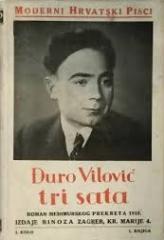
Tri sata: Roman međimurskog preokreta 1918.

Tri sata: Roman međimurskog preokreta 1918.

Đuro Vilović

The work, first published in 1935, provides a documentary account of events related to the liberation of Međimurje from Hungarian rule and its annexation to the Kingdom of Serbs, Croats and Slovenes in 1918.

Naklada Binoza, 1935.
Hrvatski. Latinica. Tvrde korice.
7,95
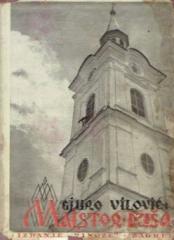
Majstor duša

Majstor duša

Đuro Vilović

The Master of Souls (1931) is one of the most controversial works of Croatian interwar literature. A psychological and social novel about a priest who faces the conflict between his priestly duty, celibacy, and human passions.

Naklada Binoza, 1931.
Hrvatski. Latinica. Tvrde korice s ovitkom.
6,84
Antologija poljske pripovijetke XX stoljeća

Antologija poljske pripovijetke XX stoljeća

Zdravko Malić

The anthology, edited and translated by Zdravko Malić, a leading Croatian Polish scholar and founder of the Polish Language Department at the Faculty of Fine Arts in Zagreb, represents a key selection of Polish short fiction from the 20th century.

Veselin Masleša, 1984.
Hrvatski. Latinica. Tvrde korice s ovitkom.
7,245,07
Priče o braku i seksu

Priče o braku i seksu

Michal Viewegh

The book contains about twenty stories connected into one whole by the main character (the writer Oskar). It is, therefore, a kind of novel that, through intimate confessions, actually talks about the loneliness of the modern intellectual.

DiVič, 1999.
Hrvatski. Latinica. Tvrde korice.
7,40 - 7,46
Devojka i golubovi

Devojka i golubovi

Jaroslaw Iwaszkiewicz

Young Edek lives with his elderly father who tries to keep his son by his side. The boy's longing for freedom and a girl clashes with his father's possessiveness. The pigeons symbolize unattainable freedom. The conflict leads to a tragic ending.

Svjetlost, 1965.
Srpski. Latinica. Broširano.
2,14
Prvo šišanje

Prvo šišanje

Bohumil Hrabal

The First Haircut, a short story written in 1970 and published in 1976, is the first in a series of prose pieces by Bohumil Hrabal describing Nymburk, the town where he spent his childhood. In 1981, The First Haircut was adapted for the screen by Jiry Men

24 sata, 2007.
Hrvatski. Latinica. Broširano.
7,24