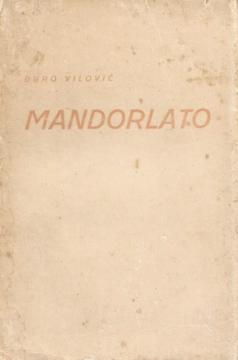
Mandorlato
Antiquität

Mandorlato

Đuro Vilović

Mandorlato (1924) is a collection of short stories/novellas from the author's early period of work, marked by psychological portraits, erotic motifs, and social criticism, typical of his controversial interwar oeuvre.

Đuro Vilović (1889–1958), one of the most widely read, but also most controversial Croatian writers of the interwar period, published Mandorlato in 1924 in Zagreb. The book belongs to his early novel collections, along with Zagaljene živote (1923) and later Hrvatski sjever i jug (1930).

The title Mandorlato (Italian for almond cake/drink) suggests a bittersweet, exotic or sensual atmosphere, which is in line with Vilović's style, which often combines erotic, psychological and social motifs. The collection contains several short stories that depict human passions, internal conflicts, love and social dramas, often with an autobiographical overtone. Vilović, a former Catholic priest who left the profession, often deals with themes of forbidden love, the hypocrisy of civil morality, sexuality and the conflict of the individual with his environment.

Stylistically, the work moves between realism and psychological prose with naturalistic and fin-de-siècle elements. Vilović writes in a lively, accessible language, often with an emphasis on emotional crises and social criticism, which brought him great popularity with the audience, but also harsh criticism from conservative circles (especially because of the anticlerical motifs in other works). Mandorlato is one of his earlier works, written after leaving the priesthood, when the author intensively dealt with the themes of personal freedom and liberation from old norms.

In the broader context of Vilović's oeuvre, this collection precedes his more famous novels such as Međimurje (1923), Majstora duša (1931) and Tri sata (1935). Like most of his works from the 1920s, Mandorlato reflects the author's tumultuous biography — from rightist and Catholic priest to Yugoslav Unitarian — and his penchant for controversial, provocative topics.

Maße
20 x 14 cm
Seitenzahl
150
Verlag
Tisak jugoslovenske štampe d.d. u Zagrebu, Zagreb, 1924.
 
Latein Schrift. Taschenbuch.
Sprache: Kroatisch.

Angeboten wird ein Exemplar

Zustand:Gebraucht, in sehr gutem Zustand
Nachteile/Unannehmlichkeiten:
  • Slight damage to the cover
Zum Warenkorb hinzugefügt!
 

Interessieren Sie sich für ein anderes Buch? Sie können das Angebot über unsere Suchmaschine suchen und finden oder Bücher nach Kategorien durchsuchen.

Diese Titel könnten Sie auch interessieren

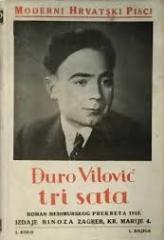
Tri sata: Roman međimurskog preokreta 1918.

Tri sata: Roman međimurskog preokreta 1918.

Đuro Vilović

The work, first published in 1935, provides a documentary account of events related to the liberation of Međimurje from Hungarian rule and its annexation to the Kingdom of Serbs, Croats and Slovenes in 1918.

Naklada Binoza, 1935.
Kroatisch. Latein Schrift. Hardcover.
7,955,96 €
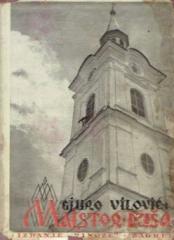
Majstor duša

Majstor duša

Đuro Vilović

The Master of Souls (1931) is one of the most controversial works of Croatian interwar literature. A psychological and social novel about a priest who faces the conflict between his priestly duty, celibacy, and human passions.

Naklada Binoza, 1931.
Kroatisch. Latein Schrift. Fester Einband mit Schutzumschlag.
6,84 €
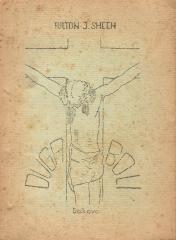
Duga boli

Duga boli

Fulton J. Sheen

Typed note from the preface: "Reproduced in cyclostyle by the theologians of the Higher Theological School in Đakovo for the use of theologians and priests only."

Visoka bogoslovna škola, 1959.
Kroatisch. Latein Schrift. Taschenbuch.
14,32 €
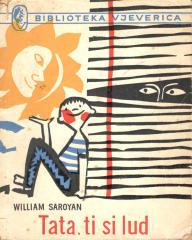
Tata, ti si lud

Tata, ti si lud

William Saroyan

"Dad, You're Crazy", a novel by William Saroyan published in 1957, and in Croatia in 1958 in the Vjeverica library, is a moving and autobiographical story told from the perspective of a ten-year-old boy, Jamie, inspired by Saroyan's son Aram.

Mladost, 1958.
Kroatisch. Latein Schrift. Taschenbuch.
21,46 €
Glorija: mirakl u šest slika

Glorija: mirakl u šest slika

Ranko Marinković

"Gloria" is a drama by Ranko Marinković, first performed in 1955, which explores the complex themes of sin, redemption, human nature and the relationship between faith and passion through strong symbolism and deep philosophical motifs.

SKD Prosvjeta, 1956.
Kroatisch. Latein Schrift. Taschenbuch mit Einband.
9,76 €
Lijepi običaji: Pogovori

Lijepi običaji: Pogovori

Julijana Matanović

A collection of selected afterwords written by the author during her ten-year editorial practice in publishing. The book rounds off this phase of her work, presenting ten essays/afterwords to contemporary Croatian prose works.

Znanje, 2000.
Kroatisch. Latein Schrift. Taschenbuch.
6,28 €