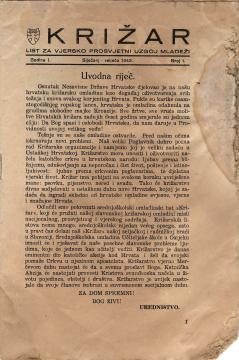
Križar: List za vjersko-prosvjetni uzgoj mladeži, br. 1.
Unique book
Antique

Križar: List za vjersko-prosvjetni uzgoj mladeži, br. 1.

"Križar", January–February 1942, the first issue of the high school youth magazine of the Teacher's School in Osijek. The newspaper of the local branch of the Crusader Movement during the NDH.

Križar was a periodical for the high school youth of the Teachers' School in Osijek, and the first issue (January–February 1942) was published as the mouthpiece of the local branch of the Crusader Movement during the existence of the Independent State of Croatia. The Crusader Movement (Križari) was a Catholic youth organization established in 1930 after the banning of the Orlovstvo, it operated in the spirit of Catholic Action and had a strong role in the religious and educational education of Croatian youth. In the NDH, it continued its work, often in cooperation with the Ustasha regime and the Ustasha youth, emphasizing Catholic identity, Croatian patriotism and moral education.

The paper is intended for students of the Teacher's School in Osijek and represents a typical example of high school periodicals of that time — a mixture of religious texts, patriotic content, literary articles, reports on the work of the Crusader societies and pedagogical topics. As the youth organ of the local Crusader branch, it promoted the values ​​of sacrifice, the Eucharist and the apostolate, with an emphasis on the Catholic education of future teachers.

In the context of the NDH (1941–1945), such papers served to strengthen the ideological and religious unity of youth, often with anti-Serbian, anti-communist and anti-liberal overtones. Križar from Osijek testifies to the strong presence of the Crusader Movement in Slavonia and to the role of Catholic organisations in the education system of the NDH.

Today this first issue is a real rarity, interesting to researchers of Croatian Catholic periodicals, the history of education and political culture in the NDH. It represents part of a wider network of Crusader publications (e.g. the Zagreb Križar) which shaped the worldview of a part of Croatian youth during the turbulent war period. Copies are kept in national and regional archives and libraries.

Editor
Stjepan Pendić
Dimensions
24 x 17 cm
Pages
32
Publisher
Veliko križarsko bratstvo i veliko križarsko sestrinstvo, Osijek, 1942.
 
Latin alphabet. Paperback.
Language: Croatian.

No copies available

The last copy was sold recently.
 

Are you interested in another book? You can search the offer using our search engine or browse books by category.

You may also be interested in these titles

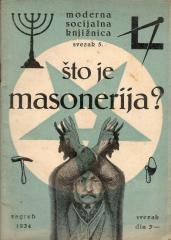
Što je masonerija?

Što je masonerija?

What is Freemasonry? (1934) is a popular pamphlet that presents the origins, organization, and activities of Freemasonry and analyzes its social, political, and cultural influence from the perspective of Catholic social doctrine.

Moderna socijalna knjižnica (MOSK), 1934.
Croatian. Latin alphabet. Paperback.
26.34
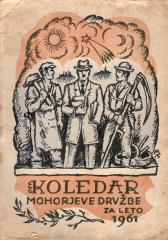
Koledar Mohorjeve družbe za leto 1961

Koledar Mohorjeve družbe za leto 1961

The Mohorjeva druzba yearbook for 1961 contains calendar information, literary contributions, historical and cultural articles, and educational texts intended for a wide range of Slovenian readers.

Mohorjeva družba, 1960.
Slovenian. Latin alphabet. Paperback.
4.26
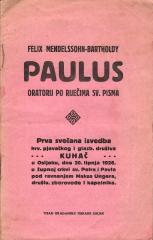
Paulus

Paulus

Felix Mendelssohn-Bartholdy

Before you is the original Osijek brochure for the ceremonial performance of the oratorio Paulus by Felix Mendelssohn-Bartholdy, held on June 20, 1926 in the Church of St. Peter and Paul in Osijek, organized by HPGD Kuhač.

Gradska tiskara, 1923.
Croatian. Latin alphabet. Paperback.
13.42
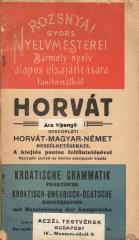
Horvát. Gyors nyelvmesterei / Kroatische Grammatik. Praktische kroatisch-ungarisch-deutsche Konversation mit Bezeichnung der Aussprache.

Horvát. Gyors nyelvmesterei / Kroatische Grammatik. Praktische kroatisch-ungarisch-deutsche Konversation mit Bezeichnung der Aussprache.

A multilingual language manual for practical learning of the Croatian language, with Croatian-Hungarian-German conversations and pronunciation notes. An interesting example for collections of old language literature and cultural and historical materials.

Aczél Testvérek, 1935.
Hungarian. Latin alphabet. Paperback.
9.32
Heinz Brandt, der Fremdenlegionär Nr. 101-110 (1915.)

Heinz Brandt, der Fremdenlegionär Nr. 101-110 (1915.)

A professionally bound set of 10 original newsstand novels from the legendary series. War issues in which Heinz Brandt, as a German soldier, takes part in the battles of World War I on various fronts. Extremely rare!

Mignon-Roman-Verlag, 1915.
German. Gothic. Hardcover.
The book consists of 11 volumes
115.00
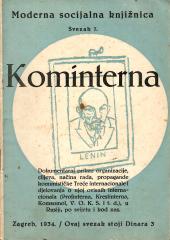
Kominterna

Kominterna

Comintern (1934) depicts the emergence, organization, and activities of the Communist International and warns of its revolutionary goals and international influence from the perspective of Catholic social thought.

Moderna socijalna knjižnica (MOSK), 1934.
Croatian. Latin alphabet. Paperback.
26.38