Jevgenij Petrov

Yevgeny Petrov (Russian: Евгений Петров), born Yevgeny Petrovich Katayev, was a Russian and Soviet writer, journalist, screenwriter, and satirist; he was born on December 13, 1902, in Odessa, and died on July 2, 1942, in a plane crash. He is best known for his collaboration with Ilya Ilf, with whom he created two classics of Russian humorous literature: The Twelve Chairs and The Golden Calf.
He grew up in a family of teachers, and his older brother was the renowned writer Valentin Katayev. After completing his education, he worked as a journalist and in the criminal investigation service. In 1923, he moved to Moscow, where he became involved in literary and journalistic circles and began publishing humorous pieces and feuilletons.
His meeting with Ilya Ilf marked the beginning of an exceptionally successful literary partnership. Their novel The Twelve Chairs (1928) follows the adventures of Ostap Bender, an ingenious con man searching for jewels hidden inside furniture. The work became famous for its sharp satire, grotesque situations, and critique of bureaucracy, greed, and social hypocrisy.
In the sequel, The Golden Calf (1931), the authors once again feature Ostap Bender, exposing the contradictions of everyday Soviet life. Together, they also wrote the satirical cycles Unusual Stories from the Life of the City of Kolokolamsk (1928) and One Thousand and One Days, or The New Scheherazade (1929).
Following their travels across the United States in 1935 and 1936, they published the travelogue One-Story America (1937), in which they examine American society, technology, culture, and everyday life with a blend of humor and critical insight.
After Ilf’s death in 1937, Petrov continued to write independently, edit magazines, and work on film screenplays. During World War II, he served as a war correspondent, reporting from the front lines. He died in a plane crash while returning from an assignment.
His work is characterized by sharp social criticism, witty dialogue, vivid characterization, and masterful irony. Together with Ilf, he left an enduring mark on Russian literature, and the character of Ostap Bender became one of the most recognizable figures in Soviet satire.
Naslovi u ponudi
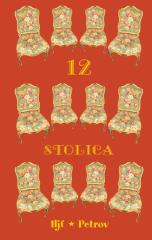
12 stolica
A satirical search for hidden treasure in post-revolutionary Russia. Former nobleman Ippolit Matveyevich Vorobyaninov and con artist Ostap Bender chase after valuables, exposing the greed and absurdities of Soviet society.
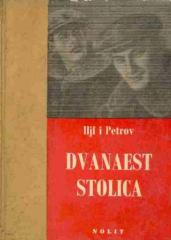
Dvanaest stolica
The main character of the novel is the ingenious swindler Ostap Bender, who this time is looking for diamonds in one of 12 upholstered chairs blown up across the Soviet Union.
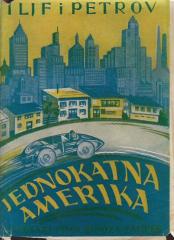
Jednokatna Amerika
After the great success of The Twelve Chairs and The Golden Calf, Ilyich and Petrov traveled the United States during the Great Depression and translated their observations into the novel One-Story America, continuing to write in a satirical style.
Kako se stvarao Robinson
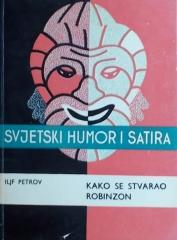
Kako se stvarao Robinzon
The work depicts the process of creating a literary hero and mocks bureaucracy, superficiality, and the artificial creation of "ideal" stories according to predetermined rules.
Prizemna Amerika
At the end of 1935, the famous Russian writing duo set off on a car trip across the United States, where they spent a total of three and a half months.
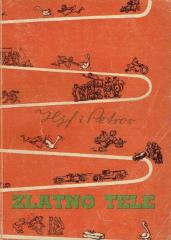
Zlatno tele
The Golden Calf (1931) is a brilliant satirical picaresque adventure, a sequel to the legendary 12 Chairs, where the great schemer Ostap Bender returns in full glory – charming, cynical, irredeemably cunning and always one step ahead of everyone else.
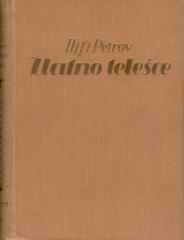
Zlatno telešce
The Golden Calf (1931) follows the ingenious con artist Ostap Bender, who in Soviet Russia during the first five-year plan seeks a secret millionaire in order to get rich, encountering the absurdity of bureaucracy, the new Soviet man, and his own downfall