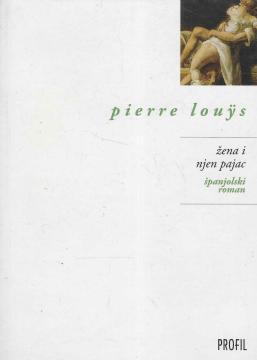
Žena i njen pajac

Žena i njen pajac

Pierre Louÿs

The novel The Woman and Her Clown by Pierre Louÿs tells the passionate story of the beautiful Conchita and her lover André, whose relationship of passion, jealousy, and humiliation shows how love can become a game of power and cruelty.

The Woman and Her Clown (1898) is the most famous work of the French writer Pierre Louÿs, inspired by the Spanish setting and eroticism of the fin de siècle. The novel tells the story of a passionate but destructive relationship between the seductive Spaniard Conchita Pérez and the wealthy Frenchman André Stévens.

At the center of the plot is Conchita – a woman of cold beauty and strong will, who uses love as a weapon. She plays with André’s feelings, alternately offering him tenderness and humiliation. An obsessive relationship develops between them in which love turns into torture and passion into destruction.

Louÿs explores the theme of female power over men, eros as a form of domination and human weakness in the face of desire. Through psychological analysis and an expressive style, the author raises the question: where does love end and addiction begin?

The novel exudes the atmosphere of Andalusia – fiery dance, dark streets and the scent of passion, introducing an exotic tone into the decadent spirit of Parisian literature of the late 19th century.

The work inspired numerous film adaptations, the most famous of which is The Devil Is a Woman (1935) by Josef von Sternberg with Marlene Dietrich in the role of the enigmatic Conchita, and That Obscure Object of Desire (1977) by Luis Buñuel, which interprets the motif of women and dolls in a more modern, symbolic key.

The Woman and her Spider remains a classic story about power, eroticism and humiliation - about love that destroys both the one who loves and the one who rules over love.

Naslov izvornika
La Femme et le Pantin
Prijevod
Marija Paprašarovski
Urednik
Maja Zorica
Dimenzije
18 x 13 cm
Broj strana
146
Nakladnik
Profil Knjiga, Zagreb, 2010.
 
Latinica. Broširano.
Jezik: Hrvatski.

Jedan primjerak je u ponudi

Stanje:Korišteno, u vrlo dobrom stanju
Oštećenja / nepogodnosti:
  • Library stamp
Dodano u košaricu!
 

Zanima Vas i neka druga knjiga? Možete pretražiti našu ponudu pomoću tražilice ili prelistati knjige po kategorijama.

Možda će Vas zanimati i ovi naslovi

Nevini lopovi: satire

Nevini lopovi: satire

Fadil Hadžić

The satirical stories of Fadil Hadžić, one of the most performed playwrights in our country, cover a wide spectrum of contemporary social, ideological, cultural and psychological peculiarities.

Globus, 1988.
Hrvatski. Latinica. Tvrde korice s ovitkom.
8,24
Dundo Maroje / Skup / Novela od Stanca

Dundo Maroje / Skup / Novela od Stanca

Marin Držić

Dundo Maroje and Novela od Stanac are masterpieces of the greatest Croatian renaissance comedy writer - Marin Držić. At the same time, these are his most famous comedies, which belong to the very top of Croatian Renaissance literature.

Školska knjiga, 1985.
Hrvatski. Latinica. Tvrde korice.
3,26
Kako podići krov

Kako podići krov

Jane Wenham-Jones

Jane Wenham-Jones, the British master of humor and irony, in the novel How to Raise a Roof leads us through the hilarious and painful adventures of Cari, a woman on the verge of financial and emotional ruin.

Marjan tisak, 2006.
Hrvatski. Latinica. Broširano.
4,36
Blefsikon: Opera

Blefsikon: Opera

Peter Gammond

"Blefsikon: Opera" is a witty and insightful book that provides a satirical view of the world of opera.

Mozaik knjiga, 1996.
Hrvatski. Latinica. Broširano.
2,64
Pomalo neobični slučajevi

Pomalo neobični slučajevi

Daniil Ivanovič Harms

The second edition of stories, sketches, anecdotes and shorter pieces by a distinctive Russian writer who has gained numerous fans among the Croatian reading public, primarily because of the laughter that balances on a thin line - the dividing line betwee

Šareni dućan, 2001.
Hrvatski. Latinica. Broširano.
10,26
Balade Petrice Kerempuha

Balade Petrice Kerempuha

Miroslav Krleža

The Ballads of Petrica Kerempuh is a collection of poems by Miroslav Krleža, published in 1936, in which the poet, through the character of the folk sage and satirist Petrica Kerempuh, depicts the difficult history of the Croatian people, especially the p

Zora, 1970.
Hrvatski. Latinica. Tvrde korice.
7,42