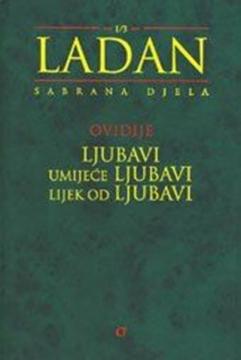
Ljubavi / Umijeće ljubavi / Lijek od ljubavi
Ovid's love elegies: The Loves (a passionate affair with Corinne), The Art of Love (a lesson in seduction and maintaining a relationship), and The Cure of Love (advice on how to get over love). An ironic, humorous, and erotic depiction of Roman love.
Publius Ovidius Nason (43 BC – 17 or 18) is one of the greatest Roman poets of the so-called Golden Age. These three works belong to his early, romantic period and represent the highest point of Roman elegiac poetry.
Loves (Amores) – a collection of three books of elegies (originally five, later reduced). The poet describes in the first person a stormy, passionate and often comic relationship with the beautiful Corina. The work is full of irony, self-irony and parody of traditional love motifs: the lover suffers, prays, kisses, envies, celebrates the body of his beloved, but everything is imbued with wit and rhetorical virtuosity. Here Ovid establishes his recognizable style – light, elegant, provocative.
The Art of Love (Ars amatoria) – a three-book didactic work (around 2 BC). The first two books are addressed to men (how to find a girl in Rome – theater, circus, banquets – and how to keep her), the third to women (how to win and keep a man). Ovid presents himself as a praeceptor amoris (teacher of love) who gives practical, often cynical and erotic advice. The work is rich in mythological examples, witty observations and subtle criticism of Roman society. It is considered one of the most influential manuals on love in history.
The Cure for Love (Remedia amoris) – a kind of continuation and counterbalance to The Art of Love. The poet advises how to free oneself from unwanted passion: avoid reminders, engage in work, travel, do not visit meeting places, consider the flaws of the loved one, etc. Here too, irony prevails – the same author who learned to love now teaches how to stop.
All three works are characterized by Ovid's brilliant technique, the lightness of verse (elegiac distich), hedonism, realism in the depiction of love (from idealization to physicality), and a subtle undermining of Augustan moral reforms. Because of The Art of Love (and probably other reasons), Ovid was exiled in Toma on the Black Sea in 8 AD, where he remained until his death.
The translation by Tomislav Ladan is considered a classic Croatian translation. Ladan (1932–2008), an accomplished translator, essayist, and lexicographer, conveyed Ovid's elegance, irony, and rhythm into the Croatian language with great skill. The translation was first published in 1973 (Znanje), with an afterword by Veljko Gortan. In Sabrani djeli Tomislava Ladan (2001), it appears in the third volume, together with an interpreter of names and concepts. This edition is appreciated among lovers of antiquity and classical literature because it combines philological precision with literary beauty.
Together, these three works form a kind of “love triptych” – from passion to technique to liberation – and remain essential reading for understanding Roman culture, erotic literature and its influence on European tradition (from the Renaissance to the present). Ladan’s translation allows the Croatian reader to fully enjoy Ovid’s wit and virtuosity.
Multiple copies are available