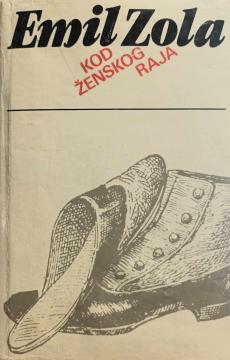

Kod ženskog raja

Kod ženskog raja

Émile Zola

This novel reveals to us the hidden world of a Parisian brothel from the beginning of the 20th century.

Taking us by the hand, Zola leads us through dark passages and secret rooms, revealing stories of courage, suffering and strength of women trapped in this cruel world.

Octave Mouret, the main character of the novel, runs a very successful Parisian fashion house and makes a lot of money selling women's clothes and things necessary for the fairer sex. Behind the shiny windows and abundance in the store hides a terrible poverty. Mure calculated well: all the housewives, small-town women and maids rushed to the cheap goods, to the restals and "coupons" displayed all the way to the street. His department store in Paris became a paradise for the senses, offering silks, perfumes, dresses, gloves, hats, linens, sewing accessories, carpets and expensive furniture. Thanks to unprecedented marketing tricks, aggressive advertising, home delivery and the possibility of exchanging purchased goods, Mure's success is enormous. However, that success has its price, both for his employees and for small traders from the region.

Denise Bodi, a twenty-year-old provincial girl who came to Paris in search of a better life, works as a saleswoman for Mure. Her thirteen-hour working hours, meager food and desperate accommodation for female workers represent the opposite of the luxury offered in Women's Paradise. After numerous attempts to win Denise's favor, Mure will have to come to terms with the fact that not everything is for sale.

Titel des Originals
Au bonheur des dames
Übersetzung
Mirjana Lalić
Editor
Radovan Ždrale
Titelseite
Bogdan Kršić
Maße
20 x 14 cm
Seitenzahl
445
Verlag
Matica srpska, Novi Sad, 1986.
 
Auflage: 10.000 Exemplare
 
Latein Schrift. Fester Einband mit Schutzumschlag.
Sprache: Serbisch.

Angeboten wird ein Exemplar

Zustand:Gebraucht, in ausgezeichnetem Zustand
Nachteile/Unannehmlichkeiten:
  • Traces of patina
Zum Warenkorb hinzugefügt!
 

Interessieren Sie sich für ein anderes Buch? Sie können das Angebot über unsere Suchmaschine suchen und finden oder Bücher nach Kategorien durchsuchen.

Diese Titel könnten Sie auch interessieren

Zver-čovek

Zver-čovek

Émile Zola

The novel explores the destructive forces of inheritance, passion, and violence in modern industrial society. The action takes place largely on the railroad, a symbol of speed, destiny, and inevitable doom. “Beast Man” is the first description of crime in

Nolit, 1940.
Serbisch. Latein Schrift. Taschenbuch mit Einband.
56,32
Trovačnica

Trovačnica

Émile Zola

The novel The Poisoner was published in sequels during 1876, and in book form in 1877. It is the story of a woman's struggle for happiness in the working class of Paris.

Rad, 1955.
Serbisch. Latein Schrift. Fester Einband mit Schutzumschlag.
8,627,49 - 9,998,62
Stranica ljubavi

Stranica ljubavi

Émile Zola
Rad, 1974.
Serbisch. Latein Schrift. Hardcover.
5,844,67
Crna kutija

Crna kutija

Amos Oz

The Black Box is a kaleidoscope of married life and love relationships. It is a novel that implicitly speaks about all of us.

Hena Com, 2001.
Kroatisch. Latein Schrift. Hardcover.
10,98
Proces

Proces

Franz Kafka

Kafka wrote The Process between 1914 and 1915, published posthumously in 1925. The novel is unfinished but with an added final chapter by Max Brod. Edition with a foreword by B. Živojinović and an afterword by Walter Killi.

BIGZ, 1990.
Serbisch. Latein Schrift. Taschenbuch.
4,26
Kreutzerova sonata, Hadži-Murat

Kreutzerova sonata, Hadži-Murat

Lav Nikolajevič Tolstoj

Kreutzer's sonata belongs to those works of Tolstoy that the writer adapted in many ways to his view on moral issues, on marital morality above all.

Civitas, 2004.
Kroatisch. Latein Schrift. Taschenbuch.
4,98